
REITs vs. Landbitt: Which is the Better Path to Real Estate Wealth?
Key Takeaways
- The Basics: A REIT (Real Estate Investment Trust) is like a mutual fund that owns income-generating properties like malls and offices.
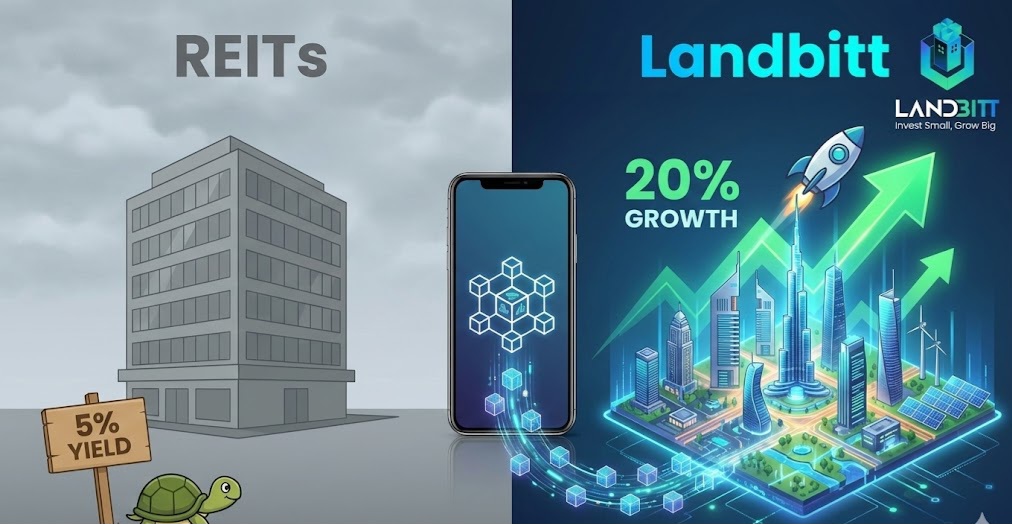
- The Limitation: REITs in India typically offer 5-7% rental yields but miss out on the massive capital appreciation of raw land.
- The Evolution: Landbitt offers “Fractional Ownership” of high-growth land in cities like Ahmedabad, Dholera SIR, and Dubai.
- The Verdict: If you want steady, low rent, choose REITs. If you want high-growth wealth creation, choose Landbitt.
The “Safe” Bet That Might Be Too Slow
If you have been researching how to invest in real estate without buying a whole building, you have definitely heard of REITs (Real Estate Investment Trusts).
They are pitched as the “Mutual Funds of Real Estate.” Ideally, you put in some money, the REIT buys a shiny IT park in Bangalore or a mall in Mumbai, and you get a share of the rent.
It sounds perfect. But ask yourself this: Do you want to earn rent, or do you want to build wealth?
There is a big difference. In India, rental yields are notoriously low (often just 3-5%). Meanwhile, land prices in developing corridors like Dholera SIR or the outskirts of Hyderabad are doubling every few years.
At Landbitt, we believe the old REIT model is good for safety, but bad for growth. Here is why the modern investor is moving towards Fractional Land Ownership.
What is a REIT? (The “Mall” Analogy)
Think of a REIT as a giant landlord.
A company gathers money from thousands of investors. They use that money to buy completed commercial buildings—offices, malls, or warehouses. These buildings earn rent from tenants. That rent is distributed back to you as a dividend.
It is simple. It is regulated. But it has limits.
- Low Growth: Since the building is already built, the price appreciation is slow.
- Commercial Focus: Most Indian REITs only focus on Grade-A office spaces. You can’t invest in that booming residential plot in Ahmedabad.
- No Control: You own a share of a company, not a specific piece of land.
Why Landbitt is the “REIT 2.0”
We looked at the REIT model and realized it was missing the biggest opportunity in real estate: Land Appreciation.
Historically, the biggest money in India, Dubai, or Singapore wasn’t made by collecting rent. It was made by buying land early in a growth corridor and holding it.
Landbitt allows you to do exactly that, but with the ease of a REIT.
1. High-Growth Locations (Global Reach)
REITs usually stick to established city centers where growth has peaked. Landbitt targets high-potential zones:
- India: Dholera SIR (Semiconductor hub), Ahmedabad, Gurgaon.
- Global: Dubai (high yields), Shanghai, and Singapore.
We find the next big hotspot before prices explode.
2. Capital Appreciation vs. Rental Yield
A REIT might give you 6% a year. If you invest ₹1 Lakh, you get ₹6,000. That barely beats inflation.
With Landbitt’s fractional land ownership, you are targeting Capital Appreciation. In high-growth zones like Dholera, land prices can rise 15-20% annually during development phases. That is how you multiply wealth, not just preserve it.
Is It Safe? (The Trust Factor)
This is where people get nervous. “REITs are on the stock market; is Landbitt safe?”
We use technology to make it safer and more transparent than traditional deals.
The Blockchain Advantage
We use the Polygon Blockchain to tokenise real estate.
- Proof of Ownership: When you invest, you get digital tokens recorded on a public ledger. No one can delete or fake this record.
- Transparency: You can see exactly how many tokens exist and who owns them.
The Legal Structure (SPV)
Just like a REIT, we don’t hold the land in a personal name. Each property is held by a Special Purpose Vehicle (SPV)—a private company created solely to own that asset. When you buy tokens, you are legally buying a share of that SPV.
Conclusion: Choose Your Lreit-vs-fractional-ownership-real-estate-indiaane
REITs are a great tool if you are retired and want a safe, slow monthly income.
But if you are in your 20s, 30s, or 40s, you need growth. You need assets that work as hard as you do.
Don’t settle for 5% returns when the world’s fastest-growing cities are being built right now. From the sands of Dholera to the skylines of Dubai, the opportunity is massive.
Stop renting the future. Own it.
Visit Landbitt.com today to explore high-growth fractional ownership opportunities that outperform traditional REITs.