

Fractional Land Investment in India: The Complete Guide for Smart Investors
Land has always played an important role in Indian wealth creation. For many families, land represents security and long-term value. However, buying land directly is not easy. Prices are high. Legal checks take time. In addition, managing documentation can feel overwhelming.
Because of these challenges, many investors look for alternatives. This is where fractional land investment in India becomes relevant. Instead of purchasing an entire plot, investors can participate through a structured model with clear ownership rights. As a result, access becomes easier and more transparent.
Platforms like LandBitt support this approach through legally compliant structures. Therefore, investors can participate in real land assets without handling the full operational burden themselves.
In this guide, you will learn how fractional land investment works, why it matters today, how LandBitt structures participation, and what risks and returns investors should understand.
What Is Fractional Land Investment in India?
Fractional land investment in India is a structured way for multiple investors to jointly participate in a land asset. Each investor holds a defined share based on the amount invested. In other words, ownership is divided proportionally.
Unlike informal group ownership, structured fractional models use legal entities such as a Special Purpose Vehicle or a trust. Because of this structure, rights and responsibilities are clearly documented from the beginning.
Typically, the process works as follows:
- First, a land parcel is identified in a growth corridor.
- Next, legal and title checks are completed.
- Then, an SPV, often structured as a trust, acquires the land.
- After that, investors participate as beneficiaries according to their share.
- Finally, returns are realized when the land is sold.
Since raw land usually does not generate rental income, fractional land investment in India focuses mainly on capital appreciation. Therefore, it is generally suited for medium to long-term investors.
Why Fractional Land Investment Is Becoming Popular
Several factors are increasing interest in fractional land investment in India.
First, infrastructure development continues across the country. New highways, industrial parks, and logistics hubs often increase demand for nearby land. As connectivity improves, land values may rise over time.
Second, investors want diversification. Equity markets can be volatile. Fixed income returns can change. Therefore, adding real assets such as land may help balance a portfolio.
Third, technology has improved access. Today, investors expect documentation, updates, and structured governance. Because of digital platforms like LandBitt, this information is easier to access and review.
As a result, fractional participation allows investors to access land without committing very large amounts of capital.
How LandBitt Structures Fractional Land Investment
LandBitt operates as a compliance-focused PropTech platform. It enables fractional land investment in India through structured and legally defined models.
Most importantly, LandBitt uses an SPV structured as a trust. The trust legally owns the land. Investors become beneficiaries of that trust according to their investment share. Therefore, ownership remains centralized while economic rights are clearly divided.
This model offers several benefits:
- Clear and centralized land title
- Documented beneficiary rights
- Defined governance rules
- Pre-agreed exit process
Before acquiring any asset, LandBitt conducts due diligence. For example, it verifies the title chain, checks for encumbrances, and reviews zoning rules. In addition, compliance checks are completed under relevant state laws.
Because of this structured approach, investors gain clarity before committing capital.
Benefits of Fractional Land Investment
Lower Capital Requirement
First of all, investors do not need to purchase an entire land parcel. Instead, they participate proportionally. Therefore, capital allocation becomes more flexible.
Access to Growth Corridors
LandBitt identifies locations supported by infrastructure plans. As a result, investors gain exposure to areas that may be difficult to access individually.
Professional Due Diligence
Legal and regulatory checks are completed before acquisition. Consequently, avoidable risks may be reduced.
Structured Governance
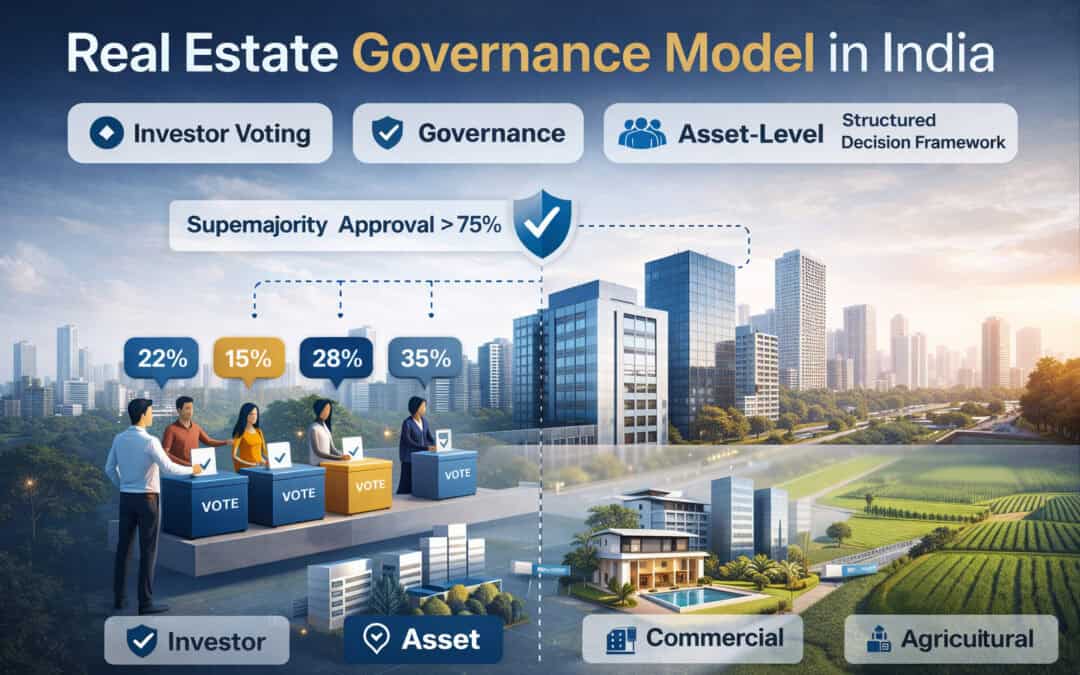
The trust deed defines decision-making rules in advance. Therefore, disagreements about exit timing or asset management are addressed within a clear framework.
Portfolio Diversification
In addition to equities and debt, land can serve as a real asset component. However, allocation should match each investor’s risk profile.
How Returns Are Generated
In most cases, fractional land investment in India generates value through appreciation rather than rental income.
Land value may increase due to:
- Infrastructure expansion
- Urban growth
- Improved road connectivity
- Industrial development nearby
When the land is sold, sale proceeds are distributed among trust beneficiaries based on their ownership share. However, potential returns depend on several factors.
- Location fundamentals
- Entry valuation
- Holding period
- Overall market conditions
Therefore, returns are not fixed or guaranteed. Investors should evaluate timelines and risk tolerance carefully.
Risks in Fractional Land Investment
Like any investment, fractional land investment in India involves risks. Understanding them is essential.
Market Risk
Land prices can fluctuate. If development slows, appreciation may take longer than expected.
Liquidity Risk
Land is less liquid than listed securities. Therefore, exit timelines may vary.
Legal Risk
If due diligence is weak, title disputes may arise. For this reason, structured verification is critical.
Governance Risk
Since multiple investors are involved, disagreements may occur. However, LandBitt’s trust structure defines rules in advance to reduce this risk.
Overall, risk cannot be removed. Nevertheless, it can be managed through structure and transparency.
Fractional Land Investment vs Direct Purchase
Direct Land Purchase
- Full control over the asset
- High capital requirement
- Individual legal responsibility
- Limited diversification
Fractional Land Investment in India
- Lower capital commitment
- Shared exposure to risk
- Structured governance model
- Limited individual control
Therefore, the choice depends on investor goals, experience, and liquidity needs.
The Future of Fractional Land Investment in India
Looking ahead, infrastructure growth is expected to continue. Industrial corridors and logistics networks are expanding. As a result, demand patterns for land may evolve further.
At the same time, digital property platforms are improving transparency. Investors now expect structured documentation and reporting. Because of this shift, compliance-focused models may gain wider acceptance.
Fractional land investment in India is likely to become more standardized. Platforms such as LandBitt focus on structured governance rather than speculative positioning. Therefore, disciplined execution will remain central to long-term credibility.
Conclusion
Land remains an important asset in India. However, direct ownership requires high capital and careful legal review.
Fractional land investment in India offers structured access to land through defined legal models. When implemented through a trust-based SPV such as LandBitt’s framework, investors gain documented rights and transparent participation.
Even so, potential returns depend on market conditions, location strength, and holding period. Therefore, investors should evaluate opportunities carefully and align them with their broader financial strategy.
Frequently Asked Questions
1. Is fractional land investment in India legal?
Yes, it is legal when structured through compliant entities such as trusts or SPVs with proper documentation.
2. How does LandBitt structure ownership?
LandBitt uses a trust-based SPV model where investors become beneficiaries in proportion to their investment share.
3. What type of returns can investors expect?
Returns depend on land appreciation and market conditions. Therefore, outcomes vary and are not guaranteed.
4. What is the typical holding period?
Land investments usually require a medium to long-term horizon aligned with development cycles.
5. Who should consider fractional land investment?
Investors seeking real-asset exposure and structured participation may consider it, depending on risk tolerance and portfolio allocation goals.