
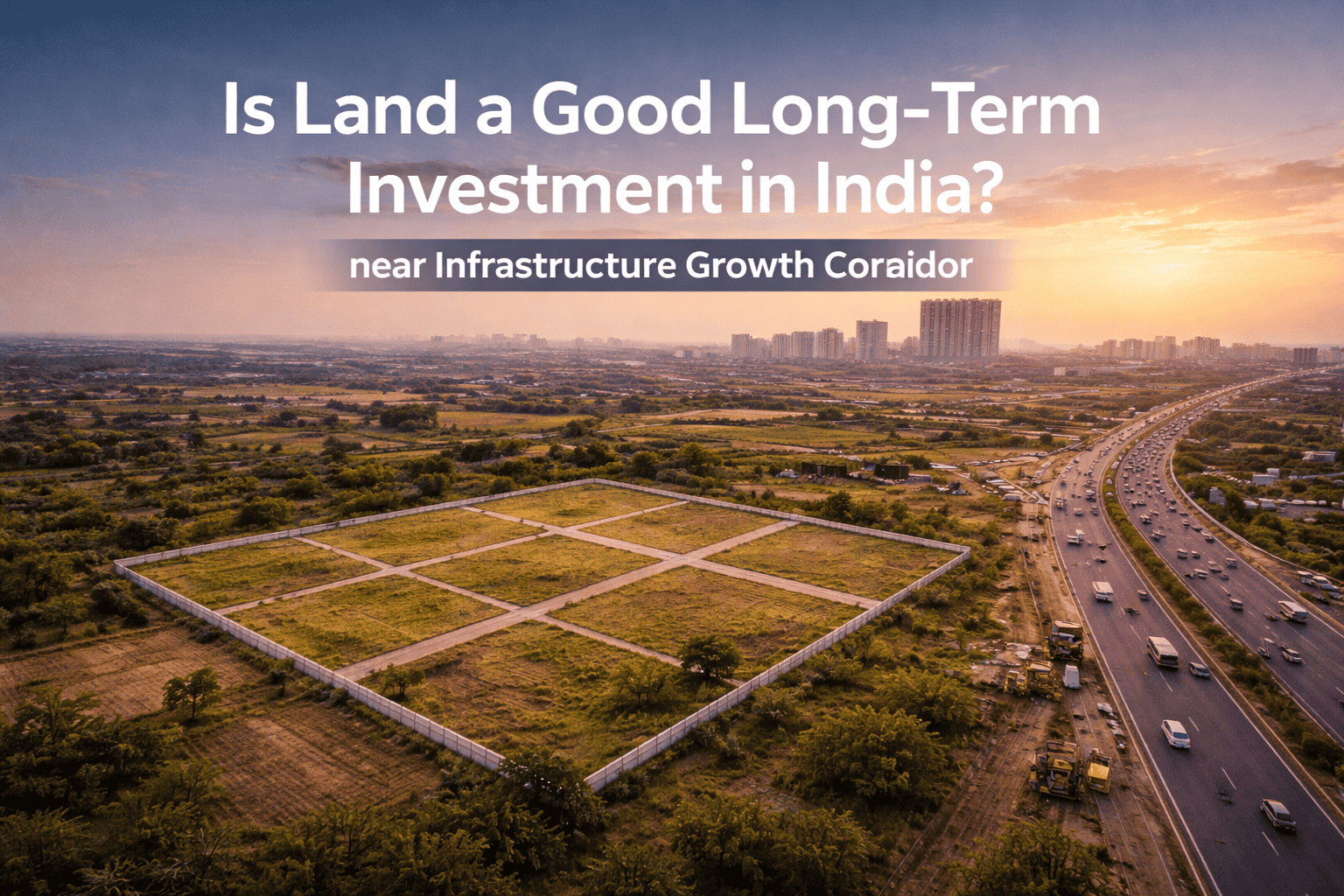
Is Land a Good Long-Term Investment in India? Infrastructure development plays a key role in long-term land appreciation in India.
Is land a good long-term investment in India? The question sounds simple, yet the answer depends on how you approach the asset. Land has created wealth for generations. At the same time, it has also locked capital for those who entered without research or strategy. Notably, infrastructure development plays a key role in long-term land appreciation in India and is a major factor to consider.
Unlike financial instruments that fluctuate daily, land moves slowly. That can be an advantage. It can also test patience. Therefore, evaluating land as a long-term investment requires understanding economics, regulation, liquidity, and structure.
Urban expansion patterns often shape long-term land investment outcomes.
Land as a Capital Growth Asset
Land does not produce value on its own. It gains value when human activity increases around it. Roads, offices, factories, housing demand, and commercial expansion are the real drivers. In fact, infrastructure development plays a key role in long-term land appreciation in India by stimulating demand and increasing access.
For this reason, land behaves differently from built property. Apartments may generate rental yield. Commercial offices may produce steady income. Raw land, however, depends almost entirely on capital appreciation.
This means one thing: time is the primary factor. Investors who expect short-term returns often become disappointed. Those who align land investment with long development cycles may see better outcomes.
What Actually Makes Land Appreciate Over Time?
When evaluating whether land is a good long-term investment in India, focus on structural drivers rather than speculation. Additionally, infrastructure development plays a key role in long-term land appreciation in India, influencing both the pace and trajectory of value growth.
1. Population Expansion
As cities grow outward, demand shifts to peripheral areas. Over time, land at the edge of development zones may gain strategic importance.
2. Employment Hubs
IT parks, manufacturing clusters, and logistics centers attract workforce migration. As employment concentrates, surrounding land demand increases.
3. Connectivity Improvements
Improved highways, ring roads, and metro lines reduce travel time. Reduced friction increases real estate viability.
4. Regulatory Clarity
Clear zoning policies and urban master plans provide direction. Areas aligned with long-term planning frameworks tend to show stronger stability.
However, each of these factors depends on execution. Announcements alone do not guarantee appreciation.
Is Land More Stable Than Other Real Estate Assets?
Land is often perceived as safer because it does not deteriorate physically. That perception has some merit. There is no tenant turnover, no building repair, and no structural aging.
However, stability does not mean liquidity. Land can remain idle for extended periods. Therefore, it may suit investors who do not require immediate cash flow.
If you are comparing ownership models, you may review Fractional Ownership vs Buying Land to understand structural differences.
Capital Allocation: Direct Purchase vs Structured Participation
Traditionally, long-term land investment required significant capital. Today, structured participation models offer alternative entry points.
Through fractional frameworks, investors participate in land assets using defined legal structures. This reduces concentration risk while maintaining exposure.
For a detailed explanation, refer to Fractional Land Investment in India.
Additionally, those evaluating listed real estate exposure may explore REIT vs Fractional Ownership in India to compare asset-backed participation models.
Structured ownership does not remove market risk. However, it introduces governance clarity and predefined exit mechanisms.
Liquidity Considerations in Long-Term Land Investment
One overlooked factor is liquidity timing. Selling land depends on finding the right buyer at the right valuation. Unlike equities, there is no daily market depth.
Therefore, investors should:
- Allocate only surplus capital
- Maintain realistic time horizons
- Avoid excessive leverage
- Prepare for delayed exits
Long-term success in land often depends more on patience than prediction.
Regulatory and Documentation Discipline
Title clarity remains fundamental. India’s property market has improved in transparency, yet due diligence remains essential.
Serious investors verify:
- Ownership history
- Encumbrance status
- Land classification
- Local development regulations
Without documentation clarity, appreciation potential becomes irrelevant.
Who Benefits Most from Long-Term Land Investment?
Land may suit:
- Investors with a 5 to 10 year horizon
- NRIs seeking geographic diversification
- Professionals building intergenerational assets
- Investors comfortable with moderate liquidity constraints
It may not suit those seeking steady income or short-term gains.
If you are new to land markets, this foundational guide may help: How Beginners Invest in Land in India.
Technology and Governance in Modern Land Investing
PropTech platforms are gradually improving governance frameworks. Digital documentation and structured investment vehicles reduce operational ambiguity.
Emerging technologies such as distributed ledger systems are also being explored to improve record integrity. You can learn more in Blockchain in Real Estate: A Technical Guide.
However, technology enhances transparency. It does not replace careful asset selection.
Final Perspective: Is Land a Good Long-Term Investment in India?
So, is land a good long-term investment in India?
It can be, if approached strategically. Land rewards discipline, location analysis, and long holding periods. It penalizes speculation and impatience. As shown throughout this article, infrastructure development plays a key role in long-term land appreciation in India and must be considered by investors.
Investors who treat land as part of a broader portfolio strategy, rather than a quick-profit idea, may find it aligned with long-term wealth objectives. Structured participation models further expand access while maintaining governance clarity.
Ultimately, land is neither inherently good nor bad. Its performance depends on fundamentals, timing, and investor behavior.
Frequently Asked Questions
1. Does long-term land investment guarantee appreciation?
No. Appreciation depends on demand, infrastructure growth, and economic conditions.
2. Is land less volatile than equities?
Land price movements are slower, but liquidity is lower.
3. Can land generate income?
Raw land typically does not generate rental income unless developed or leased.
4. Is fractional land participation suitable for long-term investors?
It may suit investors seeking structured exposure, depending on risk tolerance and time horizon.
5. What is the biggest mistake in land investment?
Entering based on speculation without verifying legal and development fundamentals.