
TL;DR: Land, gold, and stocks each solve a different problem. Land rewards patience and tends to track infrastructure growth; gold protects against inflation and gives you quick access to cash when you need it; stocks offer the highest growth potential but ask you to tolerate real volatility along the way. Most experienced investors don’t pick one — they hold some combination, sized to their own timeline and risk tolerance.

Land vs Gold vs Stocks in India: Which Is Best for You?
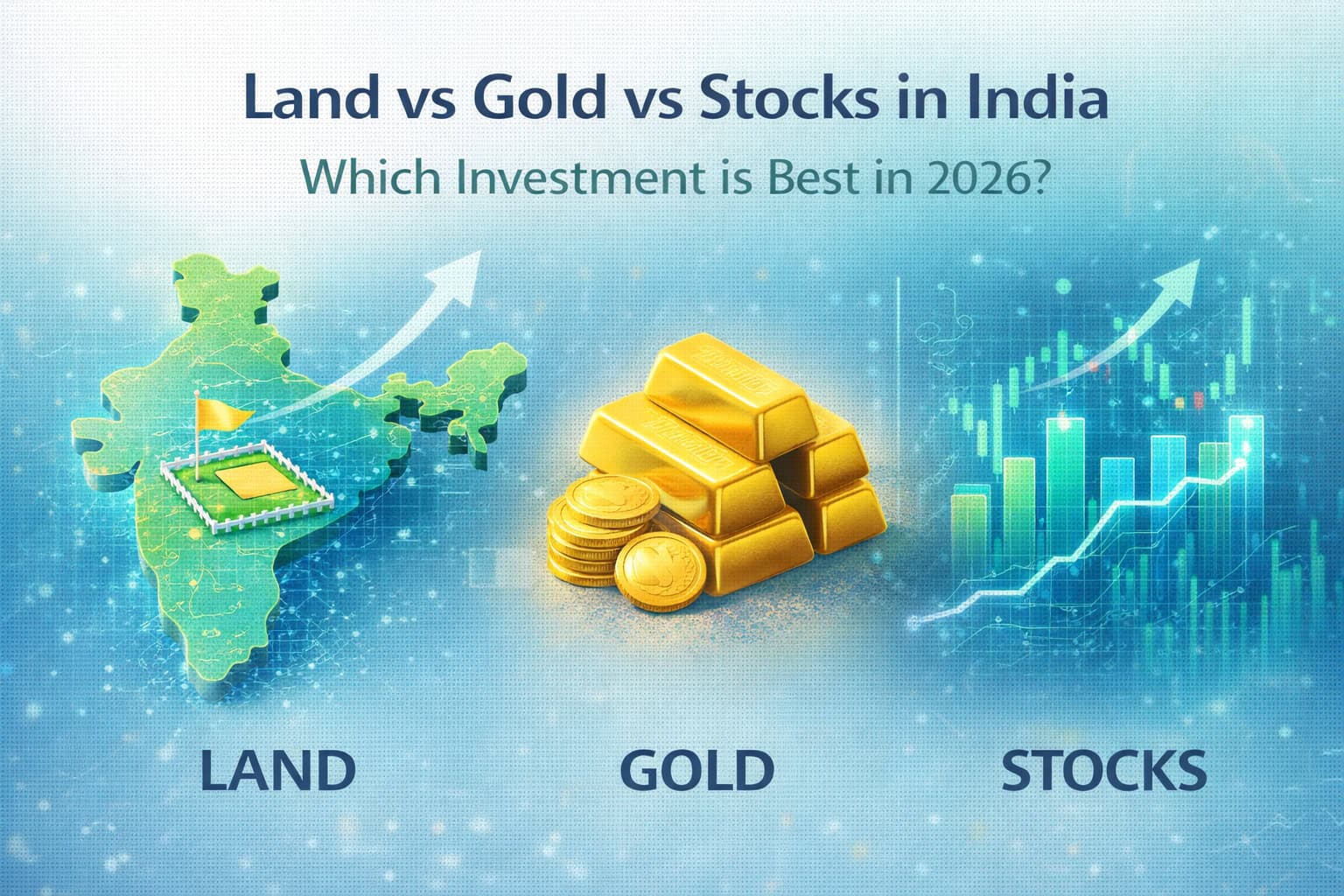
Ask ten Indian investors about land vs gold vs stocks, and you’ll get ten confident, completely different answers. That’s because the question itself is a little misleading. These three assets aren’t really competing for the same job. Land plays a long game. Gold acts as insurance. Stocks chase growth. The real question isn’t which one wins — it’s which combination actually matches what you’re trying to do with your money.
What does each asset actually do well?
Land holds up as one of India’s most trusted long-term assets, mainly because it’s genuinely scarce and tends to move with infrastructure and urban growth. It rewards people who can wait years, not months.
Gold has played the same role in Indian households for generations: a hedge against inflation and a way to convert to cash quickly when you need to. RBI’s own data on gold price trends reflects this pattern — gold has consistently held its purchasing power even through high-inflation years. It won’t make you rich, but it’s rarely the asset that lets you down badly either.
Stocks offer the highest realistic upside of the three, but that upside comes paired with real volatility. You need both the temperament and the time horizon to ride out the swings, or stocks can do more harm than good.
Land vs gold vs stocks: how do they actually stack up?
| What matters to you | Land | Gold | Stocks |
|---|---|---|---|
| Growth potential | Strong, but slow to show up | Moderate | Highest, but uneven |
| Risk level | Low to moderate | Low | High |
| Getting your money out | Slow | Fast | Fast |
| Price stability | Generally steady | Generally steady | Frequently choppy |
| Getting started | Traditionally expensive | Cheap | Cheap |
That last row is changing faster than people realize, which is worth a closer look.
Why is land investment opening up to more people right now?
Land has always had one real barrier: cost. A worthwhile plot in a growth corridor used to demand serious capital upfront, which kept it out of reach for most retail investors. That’s shifting. Structured, fractional models — including SIP-style land investing and fractional land participation — now let you build land exposure gradually instead of needing the full purchase price on day one.
Land’s underlying appeal hasn’t changed: it’s finite, and demand keeps climbing as cities and industrial corridors expand. What’s new is that more people can actually participate in that story instead of just watching it from the sidelines.
What’s the real case for gold?
Gold’s job is simple — protect value, stay liquid. When prices rise across the economy, gold tends to hold its purchasing power better than cash sitting in a bank account. And unlike land, you can convert gold to money in a day if you genuinely need to. That combination — inflation protection plus quick access — is exactly why Indian households have leaned on it for generations, even though it rarely delivers dramatic growth on its own.
What’s the real case for stocks?
Stocks give you the most direct way to participate in economic growth, and historically they’ve outperformed both land and gold over long enough periods. The tradeoff is volatility you have to actually live through — a stock portfolio can drop 20-30% in a bad year, and panic-selling during that drop is how most retail investors turn a paper loss into a real one. Stocks reward people who can stay invested through the rough patches, not just the ones who pick well.
Land vs gold vs stocks: so which one should you actually choose?
Honestly, framing it as a single choice undersells how these assets work together. A more useful way to think about it:
- Lean toward land if you’re investing for the long term and can tolerate limited liquidity in exchange for steady, infrastructure-linked growth.
- Lean toward gold if you want a stable store of value with fast access to cash when you need it.
- Lean toward stocks if you have a long time horizon and the temperament to ride out volatility for higher growth potential.
If you’re newer to land investment specifically and want a structured starting point, our step-by-step guide to investing in land in India walks through the practical side of getting started.
Does diversifying across all three actually help?
Generally, yes — and it’s the approach most experienced investors actually take rather than betting everything on one asset class. Land gives you a real-asset anchor tied to infrastructure growth. Gold gives you a hedge that holds steady when other things wobble. Stocks give you the growth engine. None of the three does everything well, which is exactly why combining them tends to smooth out the weaknesses of holding just one.
Frequently Asked Questions
Land vs gold vs stocks — which is better in India?
Each serves a different purpose: land for long-term, infrastructure-linked growth; gold for stability and liquidity; stocks for higher growth potential with more volatility. Most investors benefit from holding a mix rather than choosing just one.
Is land investment safer than stocks?
Generally yes — land tends to be less volatile day-to-day than stocks, though it’s also far less liquid, so “safer” depends on what risk you’re trying to avoid.
Can I invest in land with a small amount of capital?
Yes. Structured platforms now offer SIP-based and fractional land investment models that don’t require the full purchase price upfront.
Is gold still worth holding if I already invest in land and stocks?
Often yes, specifically for the liquidity and inflation protection it offers — it plays a different role than either of the other two, rather than competing directly with them.
What’s the best approach for a beginner?
Start by getting clear on your own timeline and risk tolerance, then build a deliberate mix across all three rather than going all-in on whichever one sounds most exciting right now.