
TL;DR: I get asked which fractional real estate platform is “the best” often enough that I want to answer it honestly. Even so, the honest answer is that there isn’t one. India’s platforms split into two structurally different groups: SEBI-regulated SM REITs like PropShare and hBits, which need roughly ₹10 lakh+ and focus on commercial office assets. There are also Trust/SPV-based platforms, including Landbitt, with lower entry points covering a broader range of asset types, including land. The right one depends on your budget and the asset type you actually want. Additionally, it depends on whether you need stock-exchange-style liquidity.

Best Fractional Real Estate Platforms in India (2026 Comparison)
I get this question a lot, in one form or another: “Which fractional real estate platform should I actually use?” I’m going to answer it as honestly as I can. This means starting with something that might sound strange coming from someone who runs one of these platforms — there isn’t a single best answer. Instead, there’s a best answer for you, depending on what you’re trying to do.
I’ve watched this market grow into something genuinely substantial. Industry estimates put it at roughly $500 million in assets under management as of 2026, and the runway is bigger than that number suggests. For example, one estimate puts the SM REIT-eligible Grade A office stock alone at over 328 million sq. ft., worth approximately $48 billion. That growth has come with real structural divergence between platforms. Understanding that divergence matters more than any ranking I could give you.
Quick Facts
- Market size: Roughly $500 million in assets under management across Indian fractional ownership platforms (2026 estimate)
- Two structural categories: SEBI-regulated SM REITs (typically ₹10L+ minimum, commercial-only, exchange-listed) vs. Trust/SPV platforms (lower minimums, broader asset types, internal marketplace liquidity)
- Regulatory shift underway: Platforms that don’t meet SEBI’s SM REIT migration criteria (₹20 Cr net worth) by mid-2026 face consolidation or wind-down
- Where Landbitt sits: Trust/SPV model, 1 sq. ft. or ₹20,000 minimum (whichever is higher), spans residential, commercial, industrial, and agricultural land
Why I Won’t Tell You There’s One “Best” Platform
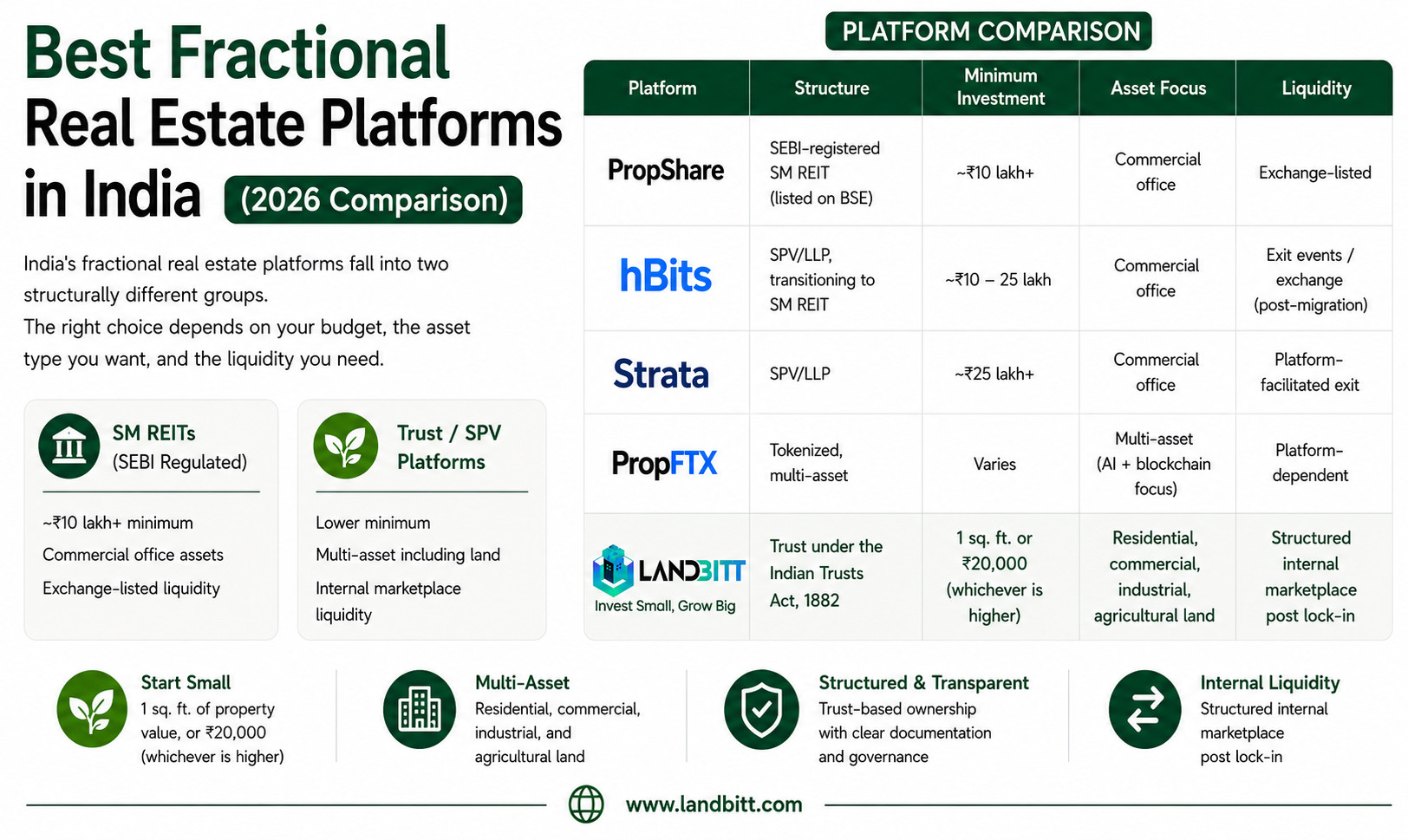
Before I get into specific names, I want to explain why I think this question deserves a more careful answer than a ranked list. Fractional real estate platforms in India broadly fall into two structurally different categories. Honestly, they’re not really competing for the same investor. I’d be doing you a disservice if I pretended otherwise just to make this comparison sound more decisive.
SEBI-regulated SM REITs came out of the March 2024 amendment to SEBI’s REIT Regulations. This created a specific framework for Fractional Ownership Platforms that pool investor funds into REIT-style units. These have to be listed on a stock exchange and need a minimum scheme size of ₹50 crore. Currently, they also carry a roughly ₹10 lakh minimum for individual investors.
Trust/SPV-based platforms — which is the model I built Landbitt on — structure each investment around a specific property’s beneficial interest through a Trust, rather than pooling into REIT units. We set our own minimum, which I deliberately kept low. We also offer liquidity through a structured internal marketplace rather than stock-exchange listing.
I don’t think either structure is “better” in some absolute sense. They’re built for different investors. The right one depends on your budget, the liquidity you actually need, and the asset type you want exposure to.
How the Platforms Actually Compare
| Platform | Structure | Minimum Investment | Asset Focus | Liquidity |
|---|---|---|---|---|
| PropShare | SEBI-registered SM REIT (listed on BSE) | ~₹10 lakh+ | Commercial office | Exchange-listed |
| hBits | SPV/LLP, transitioning to SM REIT | ~₹10-25 lakh | Commercial office | Exit events / exchange (post-migration) |
| Strata | SPV/LLP | ~₹25 lakh+ | Commercial office | Platform-facilitated exit |
| PropFTX | Tokenized, multi-asset | Varies | Multi-asset (positioned as AI + blockchain) | Platform-dependent |
| Landbitt | Trust under the Indian Trusts Act, 1882 | 1 sq. ft. of property value, or ₹20,000, whichever is higher | Residential, commercial, industrial, agricultural land | Structured internal marketplace post lock-in |
I’ve pulled these figures from each platform’s own public materials and independent sources as of 2026. Minimums and structures change, so please confirm directly with any platform before you commit capital — including mine.
Who Each Type of Platform Actually Fits
If you want SEBI-regulated, exchange-listed commercial exposure and you can meet a ₹10 lakh+ minimum, I’ll say plainly that an SM REIT like PropShare offers the most regulatory clarity currently available among the best fractional real estate platforms in India today. Mandatory listing and independent trustee oversight are real, meaningful protections.
If you want to start with a smaller amount and you’re interested in asset types beyond commercial offices — residential or agricultural land specifically — that’s the gap I built Landbitt to fill. The honest tradeoff is liquidity: your exit depends on our internal marketplace and actual buyer demand, not stock-exchange trading. I’d rather tell you that directly than let you assume otherwise.
If you’re specifically looking for the lowest possible entry point among Trust/SPV-style models, I think our 1 sq. ft. or ₹20,000 threshold (whichever is higher) is among the more accessible starting points out there right now, while still giving you access to more than one category of asset.
What I Think You Should Know About the 2026 Regulatory Shift
I want to flag something that I think matters more than most comparison articles mention. SEBI’s SM REIT framework, introduced in March 2024, was built specifically to bring previously unregulated Fractional Ownership Platforms into a transparent, listed structure. Platforms that don’t meet SEBI’s migration criteria — including a ₹20 crore net worth threshold for the Investment Manager — by mid-2026 are facing consolidation or wind-down, according to industry analysis I’ve followed closely.
Here’s what I’d actually do with that information if I were evaluating any platform, including mine: ask directly whether it operates as an SM REIT, is migrating toward one, or operates under a genuinely different structure that was never meant to become an SM REIT in the first place. For instance, this is where Landbitt sits. These aren’t interchangeable labels. They carry different regulatory obligations, minimums, and protections for you as an investor. If you want the fuller picture of how our Trust/SPV structure actually works and why I built it that way instead of pursuing SM REIT status, I’ve written about that in our guide on real estate tokenization in India.
What I’d Actually Check Before Choosing Any Platform
This is the part I’d want someone to tell me if I were on the other side of this decision:
- Get precise about the legal structure — SM REIT, SPV, or Trust — and understand exactly what that means for your rights and how you can exit
- Verify SEBI registration status directly if a platform claims SM REIT status, rather than taking a marketing page at its word
- Read the actual documentation for the specific asset you’re considering, not just the platform’s general pitch
- Be realistic about the exit timeline — exchange-listed liquidity and platform-facilitated resale are genuinely different experiences, and I think platforms (including us) should be upfront about that difference
- Match the minimum investment to your actual situation — a ₹10 lakh minimum and a ₹20,000 minimum are built for very different financial starting points, and there’s no shame in starting at either one
Frequently Asked Questions
What is the best fractional real estate platform in India?
I don’t think there’s a single best one — SEBI-regulated SM REITs like PropShare suit investors who can commit ₹10 lakh+ to commercial real estate, while Trust/SPV platforms with lower minimums, like Landbitt, suit investors who want to start smaller or access a broader range of asset types including land.
What’s the difference between an SM REIT and a Trust/SPV platform?
SM REITs pool investor funds into REIT-style units, must be listed on a stock exchange, and currently require a roughly ₹10 lakh minimum. Trust/SPV platforms, including Landbitt, link each investment to a specific property’s beneficial interest, set their own minimums, and offer liquidity through an internal marketplace rather than exchange listing.
Is the cheapest platform always the best choice?
I don’t think so, and I’d be lying if I said otherwise just because Landbitt has a low entry point. A lower minimum tells you nothing about a platform’s legal structure, asset quality, or liquidity options — all of which matter more than entry price alone.
Are all fractional real estate platforms in India regulated the same way?
No. SM REITs operate under a specific SEBI framework. Trust/SPV platforms, including Landbitt, operate under general trust and contract law rather than the SM REIT framework specifically. I’d always confirm a platform’s actual regulatory status rather than assuming.
Where does Landbitt fit among the best fractional real estate platforms in India?
I built Landbitt for the lower-budget, broader-asset-type end of this market. It is for investors who want to start small and access residential, commercial, industrial, or agricultural land specifically, rather than only commercial office space at a ₹10 lakh+ entry point.