
TL;DR: Infrastructure corridors and land appreciation in India are genuinely connected. Improved connectivity, economic activity, and population growth all follow major transportation and industrial projects. But infrastructure alone doesn’t guarantee appreciation. Execution matters more than announcements. The investors who do well here track actual project progress, rather than buying based on a press release.

Infrastructure Corridors and Land Appreciation in India
Infrastructure corridors shape economic growth and land value trends across India in a real, measurable way. Large-scale projects, expressways, industrial corridors, logistics networks, tend to improve connectivity, attract businesses, and support regional development. Those changes shift demand for land and can create entirely new growth zones over time. The part worth understanding clearly: the connection is real, but it’s not automatic. Treating an announcement the same as a completed project is one of the most common, costly mistakes investors make here.
What actually counts as an infrastructure corridor?
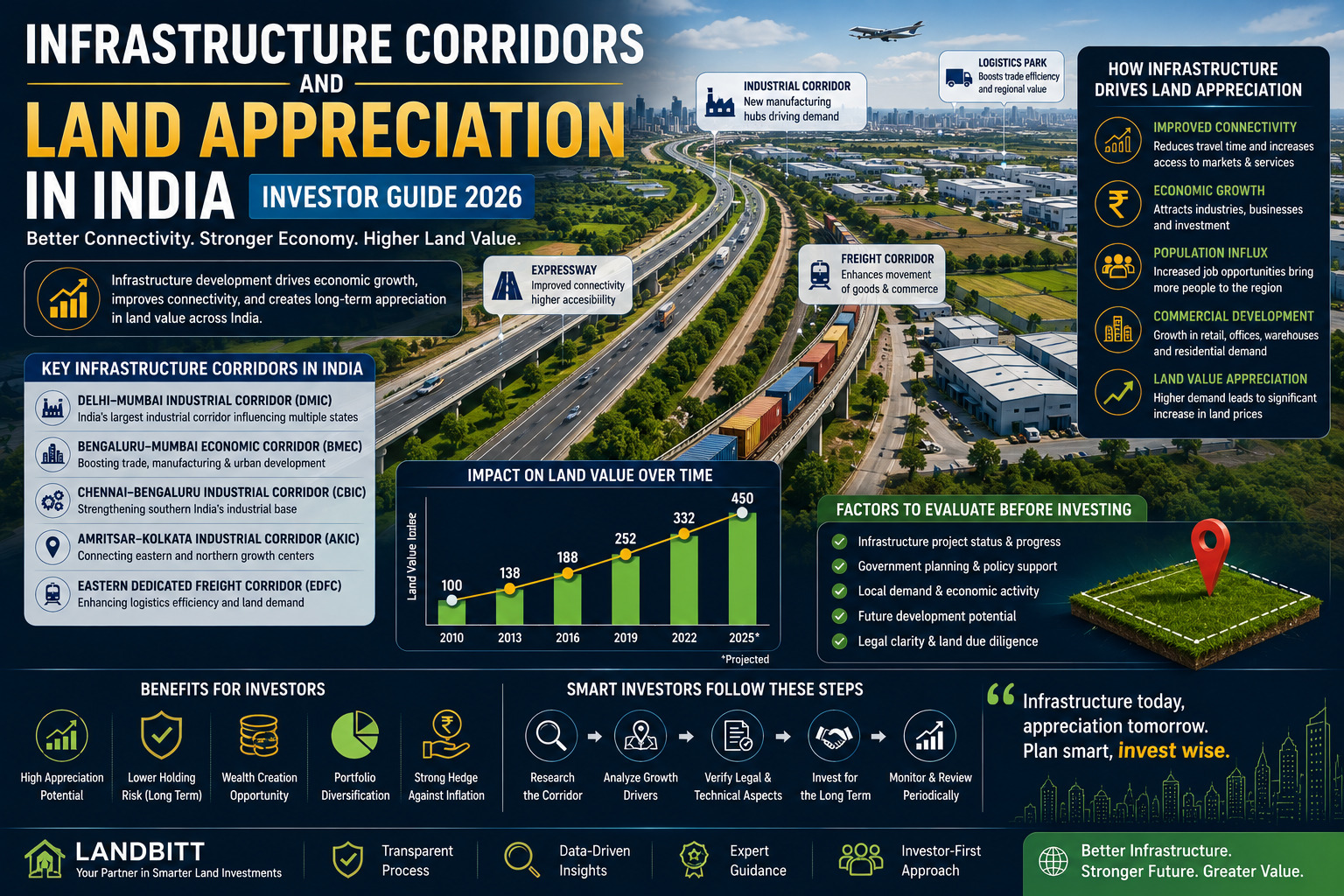
Infrastructure corridors are development zones built around major transportation and economic networks. This typically includes expressways, industrial corridors, freight corridors, logistics parks, and broader economic development zones. The underlying goal across all of them is the same. They all aim to improve connectivity, trade efficiency, and economic activity in the corridor’s footprint.
Why does infrastructure actually impact land appreciation?
Accessibility is one of the strongest drivers of land value, full stop. Infrastructure genuinely improving in an area tends to make that region more attractive to businesses, residents, and investors alike. A few specific reasons explain why.
Improved connectivity. Better transportation networks cut travel time and improve access to markets and services. That makes a location practically more usable than it was before.
Economic development. Industrial and commercial activity tends to follow major infrastructure investment, not the other way around.
Population growth. Infrastructure development can pull in workers, businesses, and entirely new communities to areas that previously had limited activity.
Which types of infrastructure actually matter most for land value?
Not all infrastructure affects land the same way.
- Expressways and highways improve regional accessibility and can stimulate surrounding development directly.
- Industrial corridors create demand for nearby land and the supporting services that follow manufacturing and logistics activity.
- Rail and freight networks support economic growth and supply chain efficiency, which matters most for commercial and industrial land specifically.
- Airports and logistics centers are major transport hubs that frequently shift nearby land demand on their own.
How should investors actually evaluate infrastructure-led growth?
Experienced investors look at several factors together rather than reacting to a single headline. They check actual project progress, not just the announcement. Government planning initiatives, real economic activity in the area, population trends, and commercial demand all matter too. Infrastructure alone doesn’t guarantee appreciation. Tracked properly, though, it’s a genuinely useful indicator of where future development is likely to concentrate.
What mistakes do investors commonly make chasing infrastructure-led growth?
A handful of mistakes show up again and again.
- Buying based only on an announcement, before any real execution has started
- Ignoring local market fundamentals in favor of the infrastructure story alone
- Overestimating how quickly appreciation will actually show up
- Skipping due diligence because the infrastructure narrative feels convincing enough on its own
Long-term research remains essential regardless of how compelling a specific infrastructure announcement sounds.
How does this connect to broader urban growth patterns?
Many infrastructure projects support wider regional development strategies, not just the immediate area around the project itself. These projects can influence commercial expansion, housing demand, industrial growth, and logistics development well beyond the corridor’s direct footprint. For how infrastructure and urban planning work together more broadly, see our guide on how smart cities are changing real estate in India.
Frequently Asked Questions
What is an infrastructure corridor?
A development zone built around transportation, logistics, and economic networks, designed to improve connectivity and trade efficiency.
Why do infrastructure projects affect land prices?
Improved connectivity and the economic activity that follows tend to increase demand for nearby land. That pushes value upward over time.
Does every infrastructure project increase land value?
No. Appreciation depends on multiple factors. Actual execution, real demand, and broader regional growth all matter, not just the existence of a planned project.
What types of infrastructure matter most?
Highways, industrial corridors, rail networks, logistics hubs, and airports tend to have the most significant influence on nearby land value.
How can investors evaluate these opportunities properly?
Research actual development progress, economic trends, connectivity improvements, and local market fundamentals together, rather than relying on any single signal.
Is infrastructure-led investing a long-term strategy?
Yes, generally. Most infrastructure projects take years to meaningfully shift regional growth and land demand. This approach rewards patience over quick timing bets.