
TL;DR: A capital gains exemption can cut or remove tax on long-term gains if you reinvest in the right asset within the time limit. For direct property, the old Sections 54 (house to house), 54F (any asset to house) and 54EC (bonds) apply. For a fractional real estate interest held through an SPV, only the 54F route is usually relevant, because the investor holds an interest in the SPV rather than land or a building.

What is a capital gains exemption?
When you sell a long-term asset at a profit, you pay tax on the gain. Under current rules, you pay 12.5% without indexation on long-term gains from property and most unlisted assets, after a holding period of more than 24 months. A capital gains exemption lets you reduce or avoid that tax by reinvesting the money in a specified asset within a set time.
The Income-tax Act, 2025 came into force on 1 April 2026 and renumbered most sections. The exemptions below still exist, but this guide uses the familiar old section numbers. Confirm the new numbers with your tax adviser when filing, or check the Income Tax Department website.
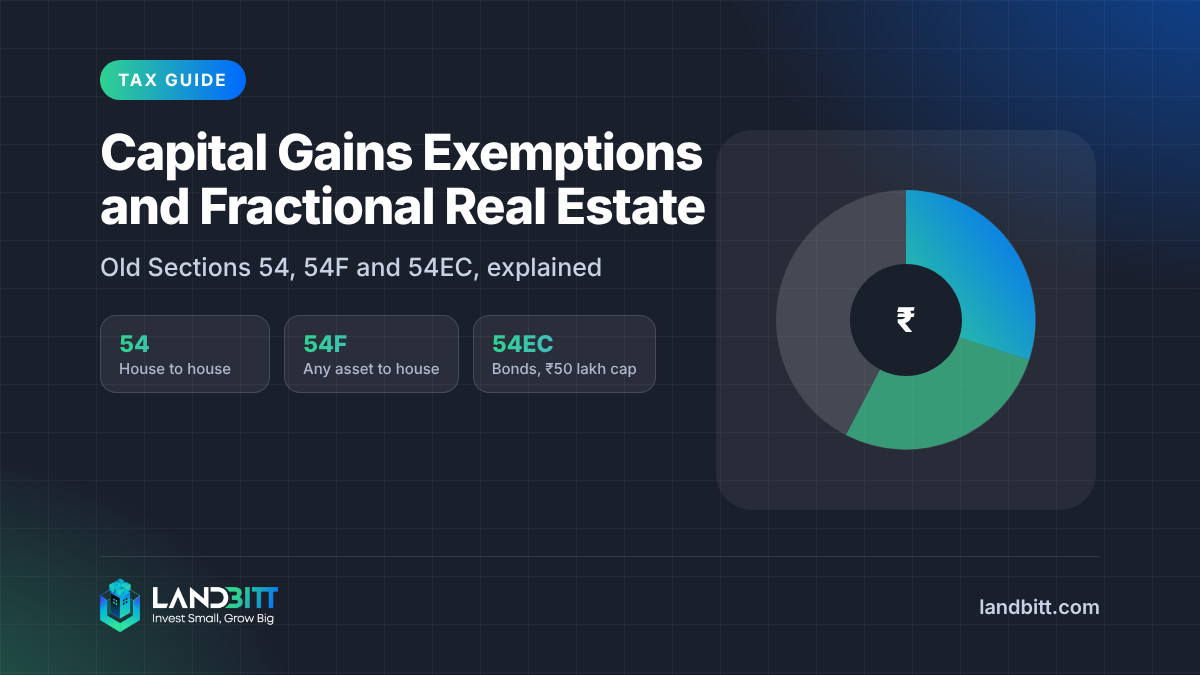
Sections 54, 54F and 54EC at a glance
| Exemption (old section) | Gain from | Reinvest in | Time limit | Cap |
|---|---|---|---|---|
| 54 | A residential house | One residential house (two, once in a lifetime, if the gain is up to ₹2 crore) | Buy 1 year before or 2 years after; or build within 3 years | ₹10 crore |
| 54F | Any long-term asset other than a residential house | One residential house, using the net sale amount | Same as Section 54 | ₹10 crore |
| 54EC | Land or a building | Specified bonds, such as NHAI, REC, PFC or IRFC | Within 6 months | ₹50 lakh per financial year |
In addition, you must generally keep the new house under Sections 54 and 54F for 3 years, and 54EC bonds carry a 5-year lock-in with taxable interest.
Which capital gains exemption applies to fractional real estate?
The answer depends on what you actually hold. Broadly, there are two cases:
- Direct co-ownership of land or a building: your share is property in your own name, so the property exemptions under Sections 54 (if it is a house) or 54EC (land or building) can apply.
- An interest in an SPV: you hold an interest in an LLP or company, not the land itself. That interest is “any other asset”, so Section 54EC and Section 54 usually do not apply. Section 54F may apply if you reinvest the net sale amount in a residential house and meet its conditions.
Moreover, if the SPV itself sells the property, the gain arises in the SPV, not in your hands. In that case, the SPV’s own tax position matters, and the tax on your payout depends on the SPV’s form. Our guide to LLP vs company SPV tax explains that part.
What conditions apply to Section 54F?
Section 54F is the route most fractional investors ask about, so its conditions deserve care:
- You must invest the net sale consideration, not just the gain. A partial investment gives a proportionate exemption.
- On the date of sale, you must not own more than one residential house, other than the new one.
- The new house must be bought within 1 year before or 2 years after the sale, or built within 3 years.
- You can park unused money in the Capital Gains Account Scheme before the return due date.
As a result, Section 54F works best for investors who were planning to buy a home anyway.
How do you plan an exit with tax in mind?
A little planning before you sell goes a long way. For example:
- Check that you have crossed the 24-month mark for long-term treatment.
- Find out exactly what you hold: direct co-ownership or an SPV interest.
- Estimate the gain and decide whether reinvesting in a house makes sense for you.
- Keep every document: purchase records, transfer records and TDS certificates.
Our guides to fractional real estate liquidity and real estate exit strategy cover the timing side, and our tax guide covers payouts and TDS.
How Landbitt fits in
On Landbitt, investors hold profit rights in an SPV, recorded as a blockchain-backed NFT certificate, starting at 1 sq. ft. or ₹20,000, whichever is higher. Because the investor holds an interest in the SPV rather than land itself, the exemption analysis above applies, and investors should confirm their position with their own adviser. Returns are not guaranteed.
General information only, not tax advice.
Frequently Asked Questions
Can I claim a capital gains exemption on fractional real estate?
It depends on what you hold. Direct co-ownership of land or a building is treated like property, so the property exemptions can apply. An interest in an SPV is a different asset, so usually only the house-reinvestment exemption under old Section 54F may be available, subject to its conditions.
Does Section 54EC apply to an SPV interest?
Generally no. The bond exemption under old Section 54EC applies to long-term gains from land or a building. An interest in an LLP or company SPV is not land or a building in your hands.
What are the limits for Sections 54, 54F and 54EC?
Sections 54 and 54F cap the exemption at ₹10 crore. Section 54EC allows up to ₹50 lakh of investment in specified bonds per financial year, with a 5-year lock-in.
How long must I hold a fractional real estate interest for long-term capital gains?
For property and for unlisted interests such as an SPV interest, the holding period for long-term treatment is generally more than 24 months. Under current rules, the tax on long-term gains is 12.5% without indexation.
Did the section numbers change under the Income-tax Act, 2025?
Yes. The Income-tax Act, 2025, in force from 1 April 2026, renumbered most provisions. The exemptions still exist, but check the new section numbers with your tax adviser when filing.
The Bottom Line
A capital gains exemption depends on what you hold. Direct property can use Sections 54 or 54EC, while an SPV interest usually points to Section 54F. Check your holding, plan the reinvestment early and confirm the details with a tax adviser.