
TL;DR: Fractional real estate liquidity in India is limited. Unlisted fractional stakes have no exchange, so you exit by selling to another investor through the platform or by waiting for the property to be sold. High ticket sizes, a small buyer pool and slow paperwork are the main reasons exits take time. Before investing, check the platform’s resale process, lock-in, fees and track record.

What does fractional real estate liquidity mean?
Liquidity is how quickly you can turn an investment into cash without accepting a big discount. A savings account is highly liquid. A plot of land is not. Fractional real estate liquidity sits in between, but it is much closer to land than to shares.
When you invest through a fractional platform, you usually hold an interest in a single property held by an SPV. Our guide on what an SPV in real estate is explains that structure. Because no stock exchange lists these interests, there is no screen where buyers and sellers meet every second. Instead, someone has to want your specific stake.
Why are exits from fractional real estate slow?
Investors often ask why Indian fractional platforms struggle to find buyers. In most cases, it comes down to five reasons:
- High ticket sizes. Many commercial fractional platforms ask for ₹10 lakh to ₹25 lakh per stake. Few retail investors can buy a stake that size, so the buyer pool is small.
- A closed marketplace. Usually, only verified investors on the same platform can buy your stake.
- Weak price discovery. With few trades, it is hard to know the fair price, so buyers and sellers disagree.
- Transfer paperwork. KYC, documentation and platform approval all add time.
- Market cycles. In a slow property market, fewer people want to buy at all.
So, is the high ticket size the main problem? It is a big one, but not the only one. Even a small stake needs a willing buyer and a clear transfer process.
How do you exit a fractional real estate investment?
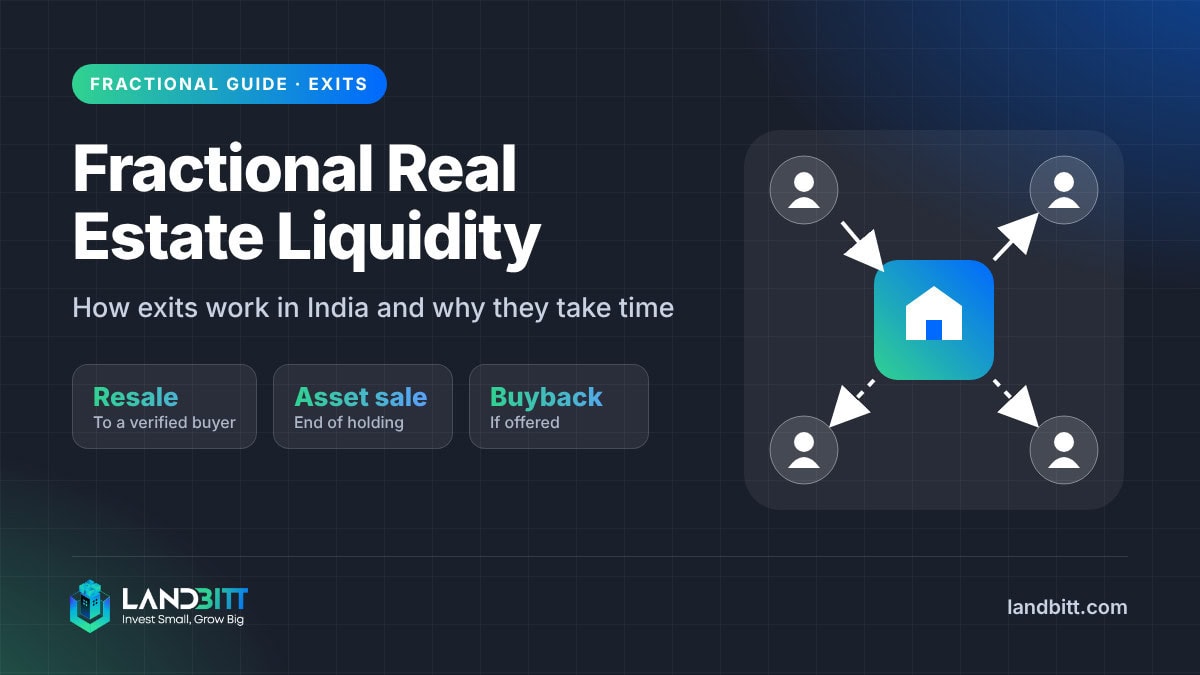
Most platforms offer one or more of these routes:
| Exit route | How it works | Typical timing |
|---|---|---|
| Resale to another investor | You list your stake and another verified investor buys it | Depends on demand; can take weeks or months |
| Sale of the property | The SPV sells the asset and distributes proceeds | At the end of the planned holding period |
| Platform buyback | The platform or a partner buys your stake, if offered | Only if the platform has such a policy |
Our guide to the real estate resale platform model explains how the first route works in practice.
How does fractional real estate liquidity compare with REITs and SM REITs?
| Option | Where you sell | Liquidity in practice |
|---|---|---|
| Listed REIT | Stock exchange, through a broker | Usually the easiest to sell |
| SM REIT (₹10 lakh minimum) | Stock exchange, through a broker | Listed, but trading can be thin |
| Unlisted fractional platform | Within the platform | Depends on buyer demand on that platform |
| Direct land or flat | Open market, through brokers or contacts | Often slow, with high transaction costs |
For a deeper comparison, read SM REIT vs fractional ownership in India. In short, if quick access to cash is your top priority, listed REITs are the better fit. Fractional real estate suits money you can leave invested for years.
What should you check about liquidity before investing?
Ask the platform these questions, and get the answers in writing:
- Is there a resale feature, and how many resales have actually happened?
- Is there a lock-in period before you can sell?
- Who sets the resale price, and what fees apply?
- What is the planned holding period for the property?
- What happens to your stake if the platform shuts down?
The last question is important. Our guide on what happens if a fractional platform shuts down covers it in detail, and our platform verification checklist lists other checks. For official rules on SM REITs, see SEBI.
How can you plan for lower liquidity?
You cannot remove liquidity risk, but you can manage it:
- Invest only long-term money. Keep your emergency fund elsewhere.
- Start small. A smaller stake is easier to sell, because more buyers can afford it.
- Spread across assets. Several small stakes give you more ways to exit than one large stake.
- Match the holding period. Choose assets whose planned timeline fits your own goals.
Moreover, read our honest guide to the risks of fractional ownership in India before you commit any money.
How does Landbitt approach fractional real estate liquidity?
On Landbitt, investors hold profit rights in an SPV, recorded as a blockchain-backed NFT certificate. To exit, you can transfer those profit rights to another verified buyer through the platform, and the platform records the transfer against your certificate. In addition, the entry amount is 1 sq. ft. or ₹20,000, whichever is higher, which widens the pool of people who can buy a stake. Even so, nobody can guarantee liquidity. It depends on buyer demand at the time you want to sell, and no one can assure returns.
Frequently Asked Questions
Is fractional real estate liquid in India?
Not very. Unlisted fractional real estate has no stock exchange, so you exit by finding another buyer through the platform or by waiting for the underlying asset to be sold. That can take weeks or months, and there is no guarantee of a buyer at your preferred price.
Why do fractional real estate platforms find it hard to find buyers?
Mainly because of high ticket sizes, a small pool of verified buyers on each platform, limited price discovery and transfer paperwork. When the minimum stake is ₹10 lakh or more, far fewer people can step in to buy your share.
Is an SM REIT more liquid than fractional ownership?
Generally, yes. SM REIT units are listed on a stock exchange, so you can sell through a broker. However, trading volumes can be thin, so selling quickly at a fair price is still not guaranteed.
How do I exit a fractional real estate investment?
Usually in one of three ways: sell your stake to another investor through the platform’s resale feature, wait for the SPV to sell the property and distribute proceeds, or use any buyback option the platform offers. Check which of these your platform actually supports before investing.
How does exit work on Landbitt?
On Landbitt, you can exit by transferring your profit rights to another verified buyer through the platform, and the platform records the transfer against your NFT certificate. A lower entry amount of 1 sq. ft. or ₹20,000, whichever is higher, widens the pool of potential buyers, but nobody can guarantee liquidity, which depends on demand.
The Bottom Line
Fractional real estate liquidity in India is real but limited. Exits depend on finding a buyer or waiting for the property sale. Therefore, check the exit routes before you invest, keep stakes small, and use only money you will not need soon.