
TL;DR: Land scarcity in India is real and economically meaningful. Unlike manufactured goods, land supply can’t expand to meet rising demand from urbanization, industrial growth, and infrastructure development. But scarcity alone doesn’t guarantee appreciation. Location, demand drivers, and development fundamentals matter just as much. Conflating “scarce” with “automatically valuable” is one of the more common mistakes new land investors make.

Land Scarcity in India: Why Limited Supply Creates Long-Term Value
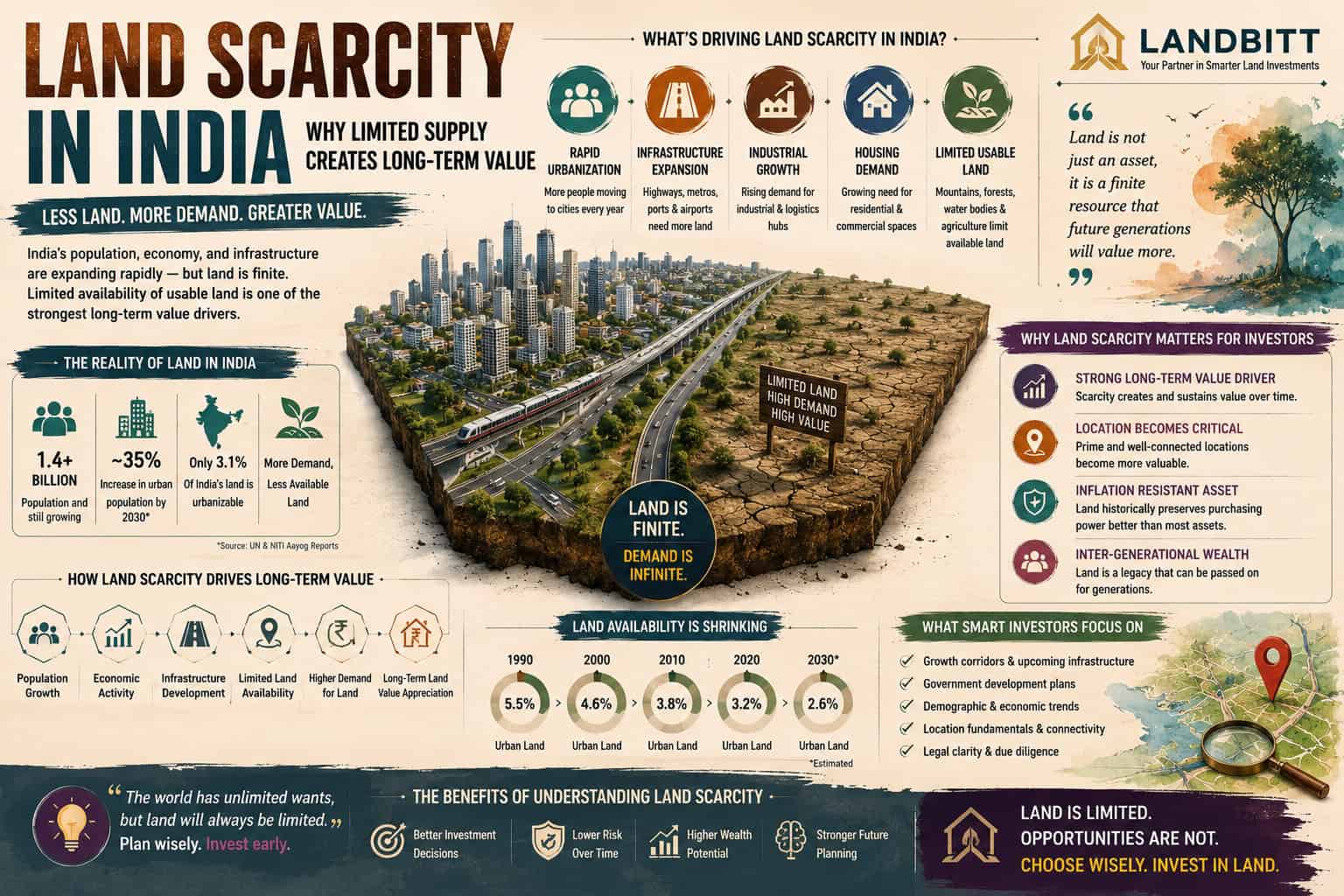
Land scarcity in India matters more every year. Urbanization, infrastructure development, and population growth keep reshaping the country’s landscape. Land is genuinely finite. New land can’t be created the way a factory can ramp up production of a manufactured good. That makes its supply inherently fixed in a way few other assets share. That said, scarcity by itself doesn’t tell the whole story. Treating it as a guarantee of appreciation is a real mistake worth avoiding.
What does land scarcity actually mean?
It refers to the limited availability of usable land relative to demand. India has a large geographical area overall, but not all of that land is suitable for development, agriculture, industry, or infrastructure. That mismatch, total land versus genuinely usable land, is what creates real competition for strategically located parcels.
Why does land scarcity matter so much in India specifically?
India’s economy, population, and urban footprint all keep growing. As cities expand and infrastructure projects develop, demand for land in the right locations often grows faster than supply can realistically respond. The pressure shows up across several fronts at once: urban expansion, industrial development, infrastructure growth, commercial demand, and housing requirements all compete for the same finite pool of genuinely usable land.
What’s the actual economic logic behind this?
Three things work together here.
Finite supply. Unlike manufactured products, land can’t be reproduced. That structural limit is a big part of why land tends to get viewed differently from other asset classes.
Growing demand. Economic activity, population growth, and regional development all push demand for strategically located land higher over time.
Location advantage. Not all land carries equal value. Accessibility, infrastructure, and genuine development potential drive demand far more than raw scarcity alone.
How does urbanization actually affect this?
Urbanization keeps reshaping India’s economic landscape directly. As cities expand outward, previously undeveloped areas can become genuinely more connected to transportation networks, employment centers, and public infrastructure. That connectivity shift is exactly what turns formerly low-demand land into something genuinely competitive. For more on how that specific dynamic plays out, see our guide on infrastructure corridors and land appreciation in India.
What misconceptions about land scarcity should investors actually drop?
A few persistent ones deserve direct pushback.
“There’s plenty of land available.” Physically, yes. But land suitable for a specific economic use, residential, industrial, commercial, is a meaningfully smaller subset than raw geography suggests.
“All land appreciates equally.” It doesn’t. Value depends on location, demand, infrastructure, and development patterns, not just on the fact that the land exists and is finite.
“Scarcity alone guarantees growth.” This is probably the most costly misconception. Scarcity is one factor among several. Skipping due diligence because an area “must” appreciate due to limited supply is exactly how investors end up disappointed.
How should investors actually evaluate scarcity-driven demand?
Rather than focusing only on supply limitations, look at the actual demand drivers behind a specific area. Check regional growth trends, real infrastructure projects (not just announced ones), genuine economic activity, population movement patterns, and urban planning initiatives that are actually being implemented. Understanding demand gives you far more useful context than scarcity alone ever will.
How might this shape India’s future development?
As India continues to develop, efficient land use and strategic planning will matter more, not less. Land scarcity is likely to keep influencing urban density decisions, infrastructure planning priorities, industrial expansion patterns, and regional growth more broadly. Genuinely usable land in high-demand corridors will keep getting harder to come by.
Frequently Asked Questions
What does land scarcity mean?
The limited availability of suitable land relative to demand, distinct from the total physical land area a country has.
Why is land considered a finite resource?
Unlike most other assets, additional land can’t be created or manufactured to meet rising demand.
Does land scarcity affect prices?
Yes, generally. Limited supply combined with growing demand tends to push land value upward over time, though the effect varies significantly by location.
Is all land equally scarce?
No. Scarcity varies meaningfully depending on location, accessibility, and the specific intended use of the land.
How does urbanization affect land demand?
Growing cities tend to increase demand for residential, commercial, and infrastructure-related land, particularly in areas gaining new connectivity.
Why should investors understand land economics, not just scarcity?
Because scarcity alone doesn’t guarantee value. Understanding supply, demand, and development patterns together gives a far more reliable picture of long-term potential.