
TL;DR: A timeshare gives you the right to use a property for a fixed period each year — nothing more. Fractional ownership, by contrast, gives you a genuine financial stake in the asset itself, typically through an SPV or Trust structure, with the potential for rental income and capital appreciation. The two products look similar on the surface but serve entirely different purposes. If you are evaluating fractional ownership vs timeshare as an investment decision, the distinction matters enormously.

Fractional Ownership vs Timeshare: What Is the Real Difference?
First-time real estate investors frequently encounter two terms that sound deceptively alike: timeshare and fractional ownership. Both involve multiple parties sharing access to a single property. However, the legal structure, financial intent, and long-term outcome differ so sharply that treating them as equivalent is a costly mistake. This post breaks down exactly where the two diverge — in plain language, without jargon.
What Is a Timeshare?
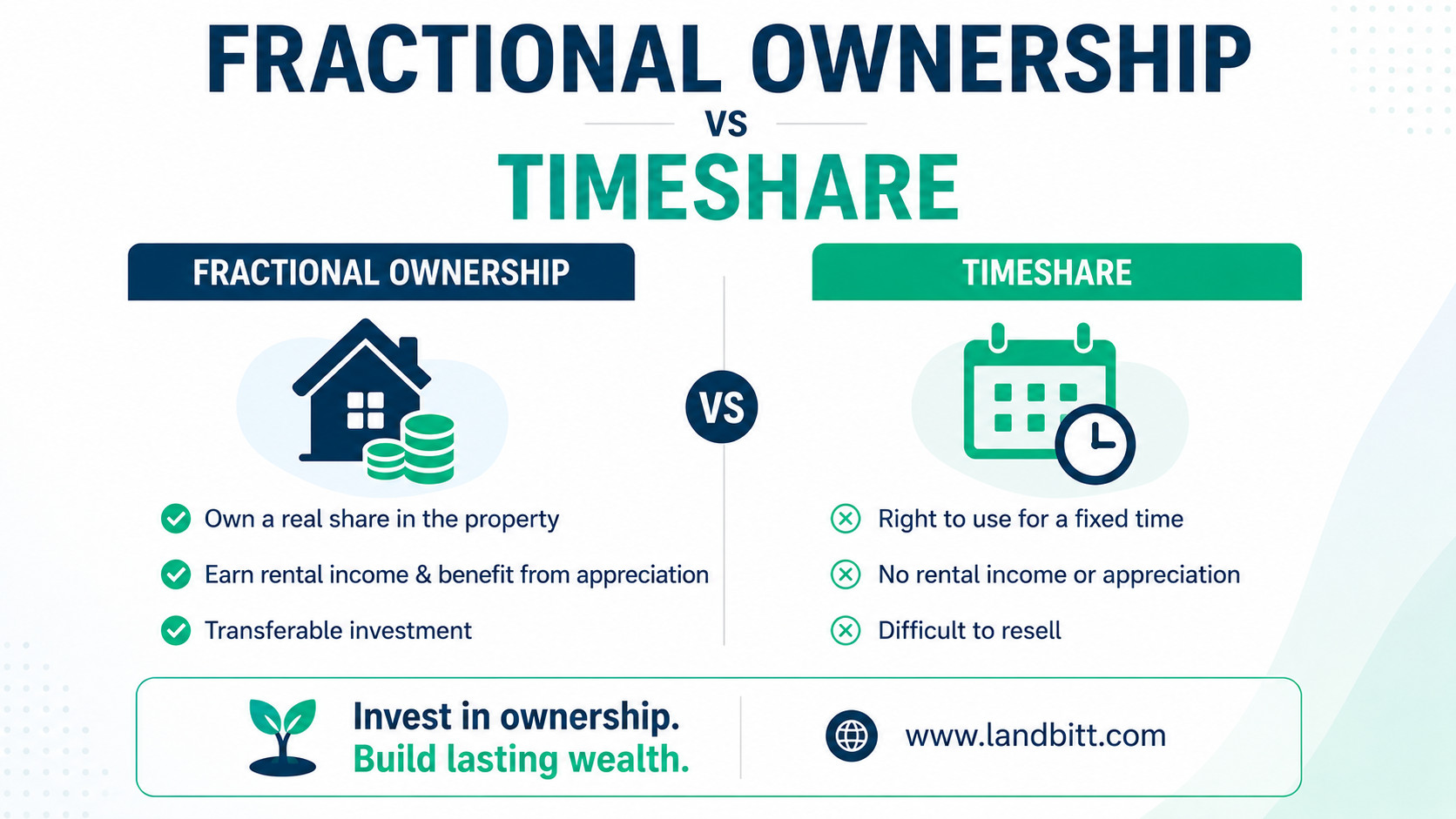
A timeshare is a contractual right to occupy a property — usually a holiday resort or vacation home — during a fixed or floating window of time each year. Typically, the developer retains ownership of the underlying property. You, as the buyer, acquire only a usage licence.
In practice, this means:
- You do not hold any equity in the real estate asset itself.
- You cannot benefit from the property’s appreciation in market value.
- You bear ongoing maintenance fees regardless of whether you actually use your allotted time.
- Reselling a timeshare is notoriously difficult — secondary markets are thin, and buyers are scarce.
Consequently, financial advisors worldwide generally classify timeshares as a lifestyle purchase, not an investment vehicle. The Reserve Bank of India’s consumer guidance on real estate transactions similarly emphasises verifying the legal nature of any property right before committing funds — a caution that applies directly to timeshare agreements, where buyers often discover post-purchase that they hold no transferable title.
What Is Fractional Ownership?
Fractional ownership, in contrast, gives you a proportional economic interest in the property itself. In India’s emerging PropTech landscape, platforms typically structure this interest through a Special Purpose Vehicle (SPV) or a registered Trust that legally holds the underlying asset on behalf of all investors.
Therefore, as a fractional owner, you stand to benefit from:
- Rental or lease income distributed proportionally to your holding.
- Capital appreciation if the asset’s value rises over time.
- A transferable stake — you can sell or transfer your interest, subject to the platform’s terms and applicable law.
Importantly, the SPV or Trust holds the property title, while you control your digital token or unit representing your economic interest. This non-custodial structure means the asset remains ring-fenced from the platform operator’s balance sheet — a structural safeguard that timeshares do not offer.
Fractional Ownership vs Timeshare: A Side-by-Side Comparison
| Feature | Timeshare | Fractional Ownership (SPV/Trust model) |
|---|---|---|
| What you acquire | Usage right for a fixed period | Proportional economic interest in the asset |
| Legal title holder | Developer retains ownership | SPV or Trust holds title on investors’ behalf |
| Rental / income potential | None (you are the user) | Yes — rental distributions flow to unitholders |
| Capital appreciation | You do not participate | You participate proportionally |
| Ongoing fees | Mandatory maintenance fees | Asset management fees (disclosed upfront) |
| Liquidity / exit | Very limited secondary market | Transferable; subject to platform terms |
| Primary purpose | Lifestyle / personal use | Financial investment and wealth building |
Why the Confusion Arises
The overlap in language is one reason investors conflate the two. Both involve ‘sharing’ a property among multiple parties, and both sometimes use the word ‘ownership’ loosely in marketing material. However, the word ‘ownership’ carries precise legal meaning — and in a timeshare, you typically own nothing more than a contractual entitlement to use.
In addition, some timeshare products in India have historically been marketed with vague promises of returns, which further blurs the line. Regulators have stepped in repeatedly: the SEBI SM REIT framework (November 2023) specifically addresses pooled real estate investment vehicles, and regulators distinguish sharply between a regulated pooled investment structure and an unregulated usage-right contract like a timeshare.
For clarity: Landbitt’s own model operates under an SPV/Trust structure and is distinct from SEBI’s SM REIT framework, which carries its own registration and compliance requirements. We do not position ourselves as an SM REIT; rather, we use an SPV and Trust arrangement to hold property on behalf of investors.
How Fractional Ownership Works at Landbitt
At Landbitt, each investment opportunity involves a registered SPV or Trust that holds the underlying land or commercial property. Investors receive digital tokens representing their fractional stake. Because the structure is non-custodial, you — the investor — control your token, while the SPV holds the physical asset.
Specifically, our minimum investment is 1 sq. ft. of the property’s value or Rs 20,000, whichever is higher, making fractional ownership accessible without requiring the large lump sums that direct property purchases demand. For more on how we structure each deal, explore how Landbitt’s SPV-based investment process works.
Furthermore, for investors interested in high-growth infrastructure corridors, Landbitt’s current focus includes opportunities in the Dholera Special Investment Region (SIR) in Gujarat — an area with substantial planned infrastructure development. You can read more in our overview of Dholera SIR investment opportunities and why the region is attracting early-stage capital.
Key Questions to Ask Before Signing Anything
Whether you are evaluating a fractional ownership platform or a timeshare offer, ask these questions before committing funds:
- Who holds the legal title? If the answer is ‘the developer’ or ‘the company’ rather than a ring-fenced SPV or Trust, you are likely buying a usage right, not an ownership stake.
- Do I participate in rental income or appreciation? A genuine fractional ownership structure passes economic benefits to investors. A timeshare does not.
- Is there a documented exit mechanism? Legitimate fractional platforms disclose how and when you can transfer or liquidate your stake.
- Are the fees and costs disclosed upfront? Timeshares are notorious for recurring maintenance fees that inflate the real cost of ownership over time.
- Is the structure regulated or registered? Ask for the Trust deed, SPV registration documents, or SEBI filing number, as applicable.
A Note on Returns and Risk
Fractional ownership in real estate carries real investment risk. Property values can fall as well as rise, rental income depends on occupancy and lease terms, and liquidity in private fractional platforms is more limited than in publicly traded instruments. No responsible platform — and certainly not Landbitt — should promise fixed or guaranteed returns or specific appreciation percentages. Treat any platform that does with significant caution.
Similarly, the legal landscape for tokenised real estate in India is still evolving. The proposed Asset Tokenisation Bill, for instance, remains a Private Member’s Bill and has not yet become enacted law. Meanwhile, blockchain records carry a legal limitation under Section 65B of the Indian Evidence Act regarding admissibility. We factor both realities into how we document and structure transactions.
The Bottom Line
The fractional ownership vs timeshare comparison ultimately comes down to one question: are you buying the right to use an asset, or the right to own an economic interest in it? For investors seeking wealth creation, only one of those answers points toward a genuine investment. Timeshares serve a lifestyle purpose and rarely build financial value. Fractional ownership through a properly structured SPV or Trust, by contrast, allows you to participate in real estate as an asset class — with income potential, capital participation, and a transferable stake.
As always, review the legal documents, understand the structure, and consult a qualified financial or legal adviser before investing. Informed decisions are better decisions.