

TL;DR: Yes, you can invest in real estate with your first salary. In India’s fractional real estate model, you can start with as little as 1 sq. ft. of property value or Rs. 20,000 — whichever is higher — through a Trust/SPV structure under the Indian Trusts Act, 1882. Consequently, the entry barrier that traditionally excluded first-salary earners from real estate has been structurally removed. However, before investing any portion of your first salary, you need to understand the legal structure, illiquidity, and documentation requirements that govern your investment.

Can I Invest in Real Estate With My First Salary? A Practical Guide
Getting your first salary is a milestone moment. Consequently, many first-time earners immediately ask whether it’s possible to invest a portion of it in real estate. The traditional answer was no — real estate required large capital, legal complexity, and long-term financial stability that most first-salary earners didn’t have. However, fractional real estate investing has changed that calculation fundamentally. This guide explains exactly how first-salary earners can access real estate investment, what the legal structure looks like, and what they must understand before committing any capital.
Your first salary can start building real estate wealth — from 1 sq. ft.
Landbitt structures every investment through a registered Trust under the Indian Trusts Act, 1882. An independent Trustee holds registered title; you hold documented profit rights via an SPV NFT certificate — not a property deed, not company equity. PMLA-compliant KYC. Starting from 1 sq. ft. or ₹20,000.
Quick Facts: First Salary Real Estate Investment
- Minimum entry: 1 sq. ft. of property value or Rs. 20,000, whichever is higher
- Legal structure: Trust/SPV model under the Indian Trusts Act, 1882
- Investor right: Profit rights via SPV NFT certificate
- Investment type: Illiquid, long-term (plan for 5–10 year holding period)
- Tax treatment: Capital gains — LTCG (>24 months) or STCG (<24 months)
- Key prerequisite: Emergency fund fully established before investing in real estate
Is Real Estate the Right First Investment for a First Salary Earner?
Before you invest your first salary in real estate, you need to answer one question honestly: is your financial foundation in place? Specifically, financial advisors and certified planners consistently recommend building a liquid emergency fund of 3–6 months of expenses before making any illiquid investment. Consequently, if you have just received your first salary, real estate should not be your first investment priority.
The Correct Order of First Investments
The recommended sequence for first-salary earners is as follows. First, build a liquid emergency fund of 3–6 months of expenses in a savings account or liquid mutual fund. Second, ensure you have appropriate health insurance — either employer-provided or personal. Third, start a tax-saving investment such as ELSS or PPF to maximize Section 80C benefits under the Income Tax Act, 1961. Fourth, once these foundations are in place, consider adding a small, structured real estate investment via the fractional model. Therefore, think of real estate as the fourth step — not the first. However, if you have these foundations in place, fractional real estate is a genuinely accessible option even at first-salary income levels.
How Much Can You Actually Invest From Your First Salary?
The amount you invest from your first salary in real estate should be money you can afford to lock away for 5–10 years without needing it for liquidity. Specifically, apply the 50-30-20 rule as a starting framework: 50% for essentials, 30% for goals and savings, and 20% for discretionary and investment choices. Consequently, for a monthly take-home salary of Rs. 40,000, your investable allocation might be Rs. 5,000–Rs. 8,000 per month across all investment categories combined. Moreover, real estate should represent one portion of your investment allocation — not the entire amount. Therefore, starting with the minimum of Rs. 20,000 as a quarterly investment is a disciplined, manageable approach for most first-salary earners.
Minimum Investment Explained
At Landbitt, the minimum investment is 1 sq. ft. of the property’s value or Rs. 20,000, whichever is higher. Furthermore, this applies per investment transaction — you are not required to commit multiple units at once. Consequently, you could start with a single Rs. 20,000 investment in one quarter and add more units in subsequent quarters as your financial position stabilises. This is exactly what makes the SIP in land investing approach practical for first-salary earners. For a full explanation of how SIP in land works, see our post on SIP in Land Investing.
What Do You Actually Own When You Invest?
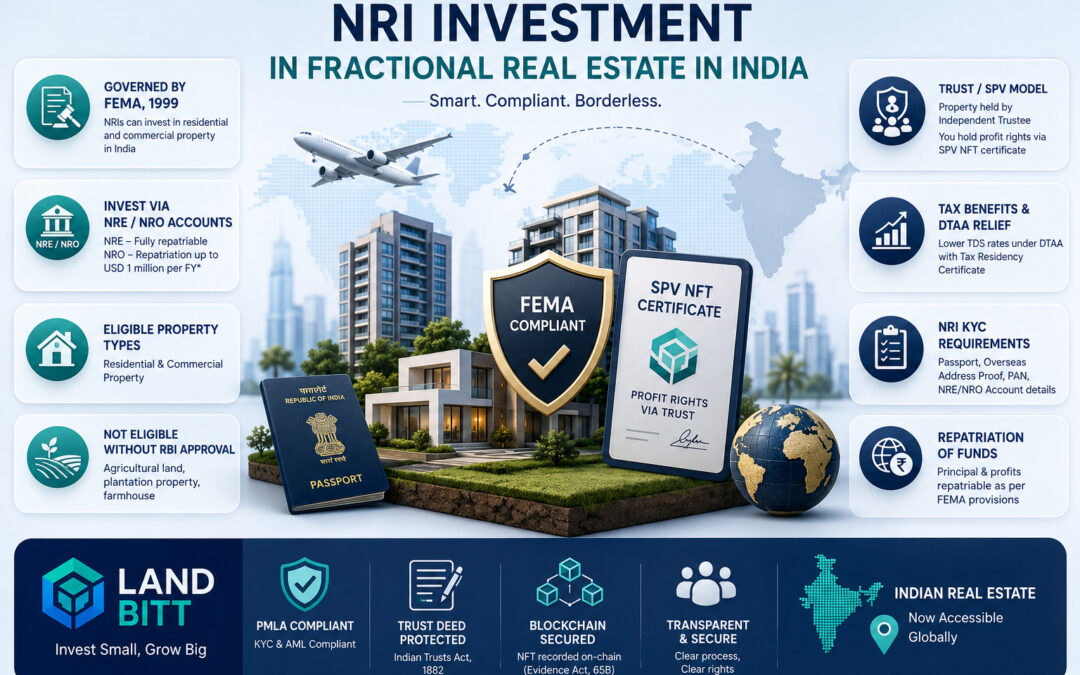
When you invest in fractional real estate through Landbitt, you receive profit rights via an SPV NFT certificate — not direct registered title to land and not shares in a private limited company. Moreover, your profit rights are governed by a registered Trust Deed under the Indian Trusts Act, 1882. Consequently, the Trustee — an independent fiduciary — holds the asset and manages it in the interest of all investors. Therefore, your profit rights are legally documented and enforceable, but they are not the same as owning land outright.
What Is an SPV NFT Certificate?
An SPV NFT certificate is a blockchain-recorded token that represents your profit rights in a specific fractional unit of a real estate asset held inside a Special Purpose Vehicle (SPV). Specifically, the certificate is recorded on-chain and links your identity to the SPV’s asset record. Furthermore, blockchain records in Indian legal proceedings are governed by Section 65B of the Indian Evidence Act, 1872 — therefore, the on-chain record must be certified appropriately for it to be admissible as legal evidence. Additionally, verify that the platform you choose documents SPV NFT certificates in a legally compliant manner.
Key Risks to Understand Before You Invest
Illiquidity Risk
Fractional real estate is not liquid. Consequently, you cannot exit your investment at any time the way you can with a mutual fund or fixed deposit. Moreover, secondary markets for fractional units are still developing in India. Therefore, only invest money you genuinely do not need for 5–10 years. As a first-salary earner, this means being honest with yourself about future financial commitments — education, career transitions, family expenses — before committing to an illiquid investment.
Platform Verification Risk
Not all fractional real estate platforms operate with the same legal rigour. Specifically, verify that the platform uses a registered Trust Deed, an independently constituted SPV, and a verifiable on-chain record for your NFT certificate. Consequently, use our Platform Verification Checklist to evaluate any platform before investing. Furthermore, if a platform cannot produce a registered Trust Deed, do not invest — regardless of how attractive the promised returns appear.
No Guaranteed Returns
Fractional real estate does not carry guaranteed returns. Moreover, any platform claiming specific CAGR or fixed return percentages on real estate investments is misrepresenting the investment. Therefore, evaluate platforms based on legal structure, asset documentation, and transparency — not projected returns. In addition, as a first-salary investor, you cannot afford to speculate. Consequently, the disciplined, documentation-first approach is not optional — it is essential.
Tax Treatment for First-Salary Real Estate Investors
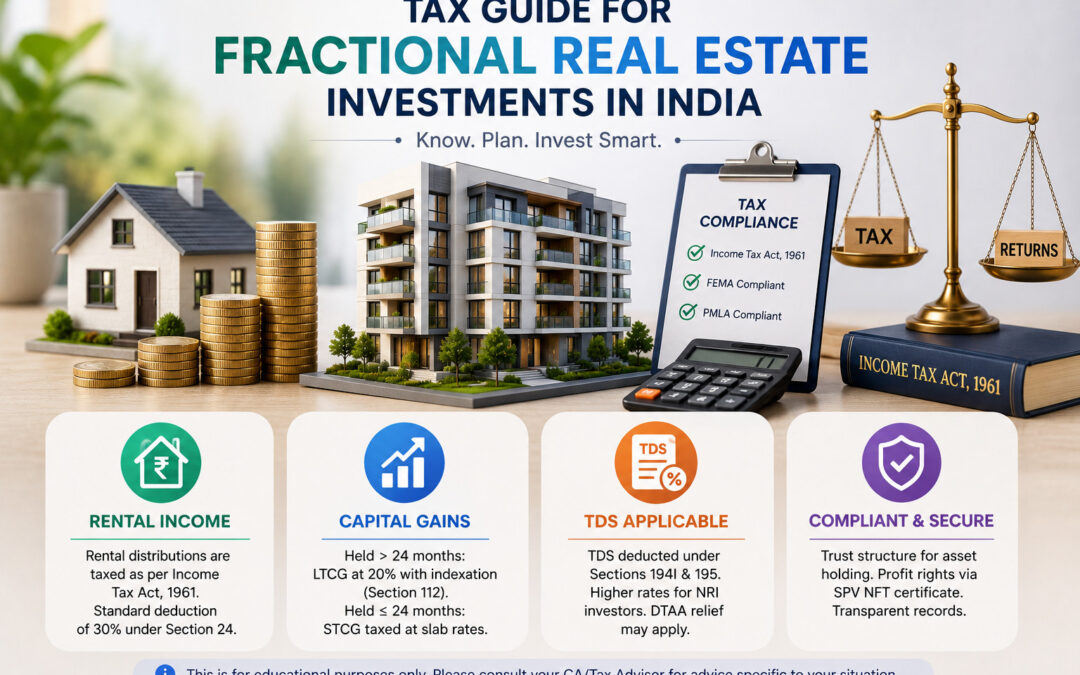
As a first-salary earner investing in real estate, you will fall into the capital gains tax framework under the Income Tax Act, 1961. Specifically, if you hold your fractional real estate investment for more than 24 months, any profit upon exit qualifies for Long-Term Capital Gains (LTCG) treatment at 20% with indexation benefit. However, if you exit within 24 months, Short-Term Capital Gains (STCG) apply at your applicable income tax slab rate. Furthermore, given that you are starting your career, your slab rate may currently be low — making this a relatively efficient entry point for real estate from a tax perspective. Consult a qualified tax advisor for your specific situation before investing. For a full breakdown, see our Tax Guide for Fractional Real Estate in India.
Frequently Asked Questions
Can I really invest in real estate with my first salary in India?
Yes. Fractional real estate investment starts at 1 sq. ft. of property value or Rs. 20,000, whichever is higher. Through a Trust/SPV model under the Indian Trusts Act, 1882, you receive profit rights via an SPV NFT certificate. However, you should build an emergency fund and basic insurance coverage before allocating any portion of your first salary to an illiquid investment like real estate.
What is the minimum investment in fractional real estate?
The minimum investment is 1 sq. ft. of the property’s value or Rs. 20,000, whichever is higher. This applies per transaction — you can start with this minimum and add more units over time through a structured, SIP-style approach.
What do I actually own when I invest in fractional real estate?
You receive profit rights via an SPV NFT certificate — a blockchain-recorded token linked to your fractional unit in a real estate asset held inside a Special Purpose Vehicle (SPV) governed by a registered Trust under the Indian Trusts Act, 1882. This is a profit rights structure, not direct registered land title or company shareholding.
Is fractional real estate liquid?
No. Fractional real estate is illiquid. You cannot exit at any time the way you can with a mutual fund. Plan for a holding period of 5–10 years. Only invest money you do not need for liquidity during that period.
What taxes apply to my first real estate investment?
Capital gains tax applies under the Income Tax Act, 1961. Investments held more than 24 months qualify for Long-Term Capital Gains (LTCG) at 20% with indexation. Investments held less than 24 months are taxed as Short-Term Capital Gains (STCG) at your income tax slab rate. Consult a tax advisor for personalised guidance.
Ready to make your first real estate investment? Create your account today.
Landbitt uses a registered Trust/SPV structure under the Indian Trusts Act, 1882. You receive profit rights via an SPV NFT certificate — not a property deed, not company equity. Build emergency fund first, then invest with us from 1 sq. ft. or ₹20,000.