

TL;DR: AI and blockchain in real estate serve two different, complementary functions. AI analyzes data — pricing trends, demand signals, infrastructure growth — to support better-informed decisions. Blockchain provides a permanent, tamper-proof record of transactions and ownership. Neither technology removes investment risk or guarantees returns. Instead, they improve the quality of information and the transparency of recordkeeping that sit underneath any actual investment decision.

AI and Blockchain in Real Estate: How They Work Together
Quick Facts
- AI’s role: Analyzes data — pricing trends, demand signals, infrastructure growth, document patterns — to support investment decisions
- Blockchain’s role: Creates a permanent, tamper-proof record of transactions and ownership
- Legal structure (unchanged by either technology): Properties remain held through a Trust under the Indian Trusts Act, 1882; investors hold beneficial interest, not direct title
- What neither technology does: Guarantee returns or eliminate market, liquidity, or legal risk
Why Real Estate Needed Better Tools
Real estate has long been one of the most trusted asset classes. However, it has also been one of the most opaque. Buyers have historically struggled with unclear ownership records, slow transactions, and limited access to verified data. AI and blockchain in real estate address these two specific problems. However, they address different halves of it.
How AI Contributes: Better Analysis, Not Predictions
AI analyzes large volumes of data — land prices, demand trends, infrastructure development, and historical patterns — to surface insights that would take a human analyst far longer to compile manually. In practice, this can include evaluating property documents for inconsistencies, flagging pricing anomalies, and modeling how infrastructure changes have historically affected nearby land values.
It’s worth being precise about what this actually means, though. AI-driven analysis is probability-based, not predictive in any guaranteed sense. It can highlight patterns and historical correlations. However, it cannot tell you with certainty what a specific property will be worth in the future.
How Blockchain Contributes: A Tamper-Proof Record, Not a Risk Eliminator
While AI supports analysis, blockchain addresses a different problem entirely: recordkeeping integrity. Property-related data — ownership history, transaction records, documentation — gets stored on a distributed ledger. No single party can alter this ledger retroactively.
Each transaction is permanently recorded and independently verifiable. This genuinely helps prevent certain kinds of fraud (like double-selling the same asset) and reduces disputes over what was actually agreed and when — for a closer look at this specific problem, see our guide on blockchain land fraud prevention in India, and for examples of blockchain already in use across government systems in India, see blockchain use cases in India: real government projects. However, it’s worth being clear about the limits here too. A tamper-proof record of a transaction does not change the underlying market risk of the asset itself. Blockchain records are not yet treated as fully conclusive legal proof of title under current Indian law.
How These Two Technologies Combine
AI and blockchain in real estate solve genuinely different problems — better-informed decisions on one side, transparent and tamper-proof recordkeeping on the other. Together, they support a more transparent due-diligence process. AI surfaces the relevant data and flags anomalies, and blockchain provides an independently verifiable record of what subsequently happens with that asset.
This combination matters specifically for structured, fractional participation models. In these models, transparency at every stage — from initial property evaluation through ongoing ownership records — directly affects how much an investor can trust the process without needing to take a platform’s word for it.
How This Fits Into Landbitt’s Structure
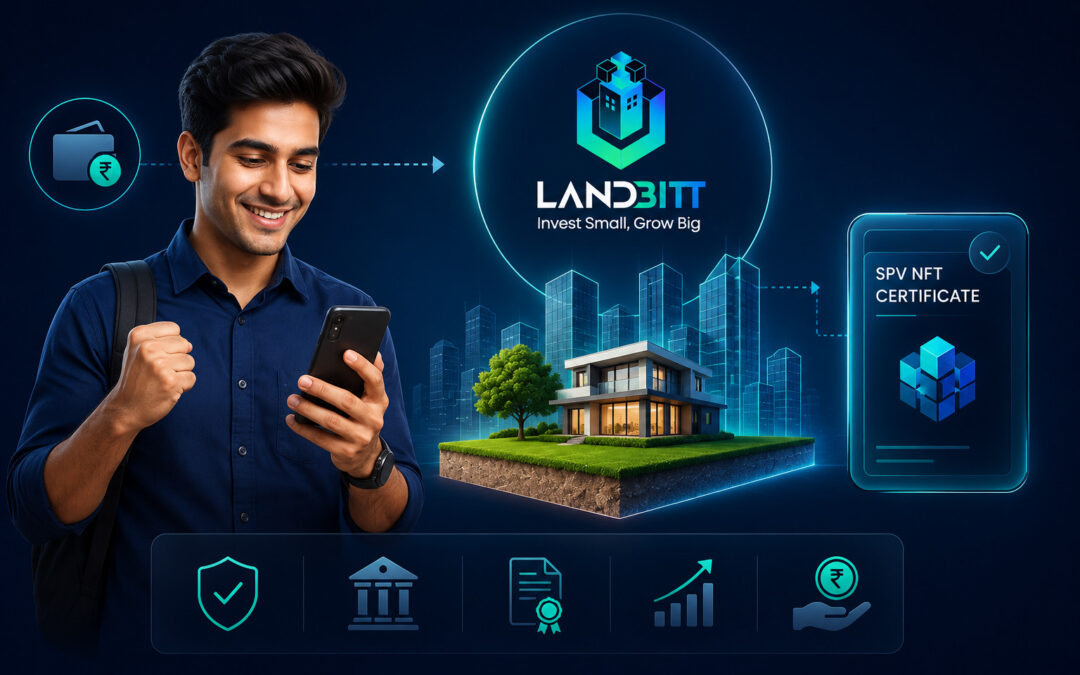
Every property on Landbitt is held through a Trust formed under the Indian Trusts Act, 1882. Neither AI nor blockchain changes this underlying legal structure — they support it. AI assists with evaluating growth potential, pricing context, and location trends during property evaluation. After that, blockchain records the resulting digital tokens, representing each investor’s beneficial interest in the Trust, on the Polygon network, where ownership records remain independently verifiable.
For the underlying legal mechanics, see our guide on blockchain in real estate, and for how this connects to fractional participation specifically, see our real estate tokenization in India guide.
What This Doesn’t Change
It’s worth stating plainly: neither AI nor blockchain removes the fundamental risks of real estate investment. Market conditions still drive value. Liquidity still depends on finding a buyer or counterparty. Legal verification still matters, regardless of how sophisticated the technology layer is. These technologies improve the quality of information and the transparency of recordkeeping. However, they do not replace careful evaluation of the underlying asset.
Frequently Asked Questions
Does AI predict how much a property will appreciate?
No. AI analysis is probability-based and can highlight historical patterns and trends, but it cannot guarantee future appreciation or any specific return.
Does blockchain make a real estate investment risk-free?
No. Blockchain improves transparency and tamper-resistance of the transaction record, but it doesn’t eliminate market risk, liquidity risk, or the need for legal due diligence.
Is a blockchain record the same as legal proof of property title?
Not yet, under current Indian law. Blockchain strengthens transparency around a transaction history, but it isn’t yet treated as fully conclusive legal proof of title in Indian courts.
How does Landbitt actually use AI and blockchain together?
AI supports evaluation of properties before they’re listed — pricing context, growth trends, and document review. Then, blockchain records the resulting digital tokens, representing each investor’s beneficial interest in the property’s Trust structure, on the Polygon network.
Do I need to understand AI or blockchain technology to invest?
No. These technologies operate in the background to support analysis and recordkeeping. You interact with a standard investment process: KYC verification, reviewing property documentation, and selecting your participation amount.