
TL;DR: Blockchain use cases in India already cover several live government systems: PropertyChain for land records, CertChain for certificate verification (already storing CBSE and Karnataka board records), DocChain for document management, and LogisticsChain for supply chain tracking. The Vishvasya stack provides shared technical infrastructure underneath all of them. None of these systems make their outputs legally conclusive by themselves — that still depends on the specific legal framework around each use case.

Blockchain Use Cases in India: An Overview of Real Government Projects
India’s blockchain adoption in government systems has moved past the pilot stage. Several real blockchain use cases in India are live today. The National Informatics Centre’s Centre of Excellence in Blockchain Technology runs them, handling real records for real citizens. Here’s a genuine overview of what’s actually running, not a speculative list of what might happen eventually.
Why do government systems benefit from blockchain specifically?
Traditional centralized databases carry a structural weakness. There’s a single point of failure, and a single point where records can get altered without anyone else noticing easily. Blockchain’s decentralized, tamper-resistant structure addresses that directly. Multiple stakeholders can verify the same record independently. That makes quiet manipulation considerably harder to pull off, and easier to detect when it happens.
What are the actual live blockchain use cases in India?
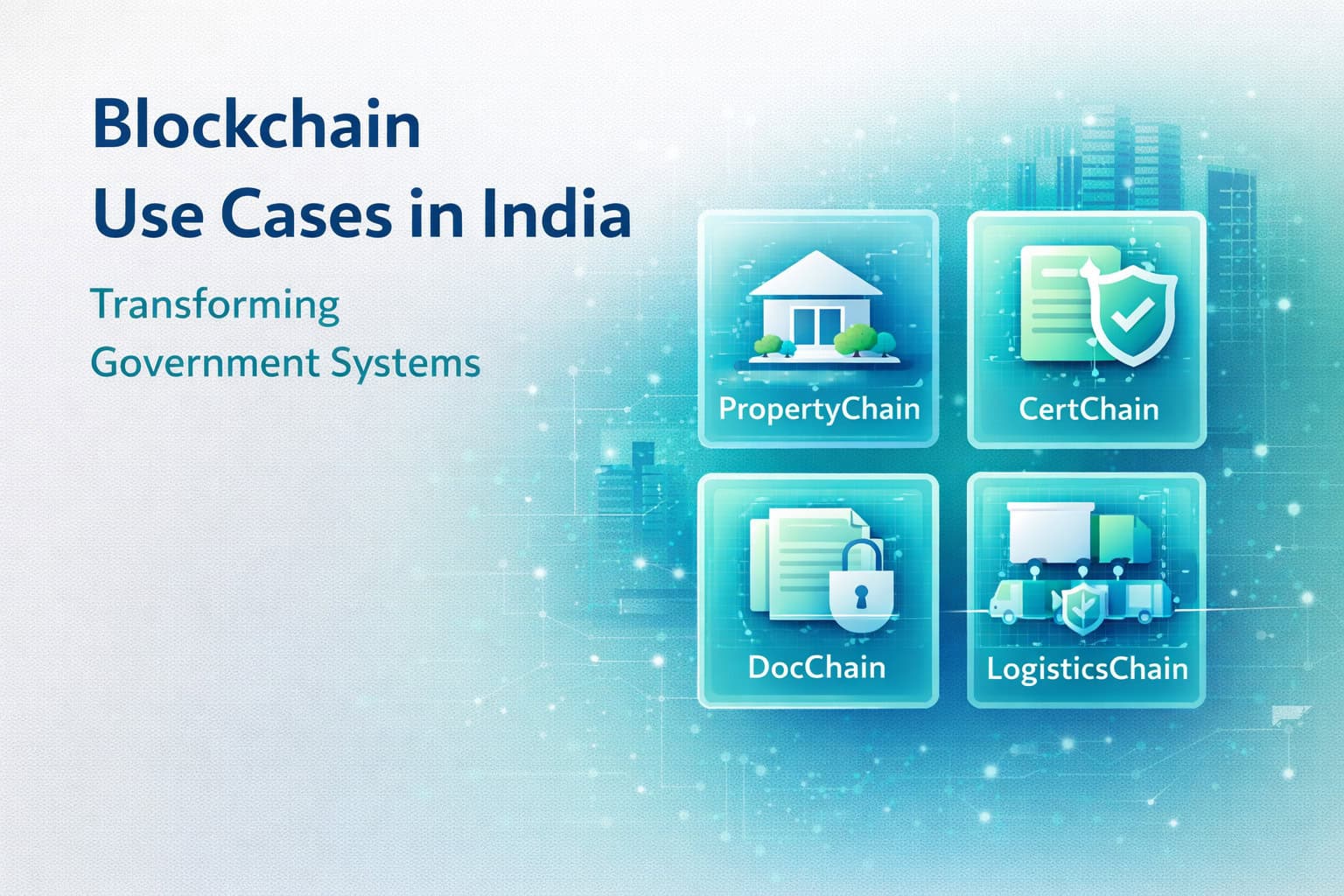
PropertyChain handles land and property record management. It digitizes ownership data and records property transactions, like sales and mortgages, in a shared, tamper-resistant ledger. For the full picture, see our guide on PropertyChain India.
CertChain verifies educational and official certificates. It’s already live. The Central Board of Secondary Education stores academic records through it. Karnataka’s education boards use it too, for SSLC and PUC marks cards. Institutions and employers can verify credentials directly this way, without relying on the issuing body to manually confirm authenticity each time.
DocChain, also called Document Chain, manages secure storage and verification for government-issued documents — identity cards, driving licenses, birth and death certificates. Any authorized agency can verify a document’s details directly through it, rather than needing to manually request confirmation from the original issuing department.
LogisticsChain tracks goods through supply chains. It lets stakeholders verify the movement and authenticity of products as they move from origin to destination. This matters most for sectors like pharmaceuticals, where verifying a product’s full chain of custody actually affects safety, not just paperwork accuracy.
How do these blockchain use cases in India connect to each other?
Vishvasya, India’s national blockchain stack, provides the shared technical infrastructure underneath all four systems above. Each project doesn’t build its own blockchain platform from scratch. Instead, Vishvasya gives them a common, vetted foundation. That foundation covers consistent security standards, interoperability, and the ability to scale to genuinely national usage. For how that infrastructure layer actually works, see our guide on Vishvasya blockchain India.
Do these systems make their records legally conclusive?
Not automatically, and that distinction matters regardless of which specific system you’re looking at. Blockchain-based records are genuinely tamper-resistant. That’s a real, meaningful improvement over centralized paper or database systems. But Indian evidence law currently requires a specific kind of certification for electronic records. A decentralized system can’t provide that certification the way the law currently expects. This gap affects land records most visibly, since title disputes carry high financial stakes. The same underlying legal question applies across these systems generally, though. For the specifics of how that plays out with land records, see our guide on digital land records in India.
What does this mean for real estate investment specifically?
PropertyChain and the broader land-records modernization effort improve the quality and reliability of the underlying property data that due diligence depends on. That’s genuinely useful context for evaluating any property-related investment. It doesn’t, however, change how a specific structured investment’s legal protections actually work. Those come from the investment’s own legal framework instead — typically a Trust or SPV holding the property, with investors holding a beneficial interest in that structure. For those mechanics, see our guide on real estate tokenization in India.
Frequently Asked Questions
What are real blockchain use cases in India?
Live government systems include PropertyChain for land records, CertChain for certificate verification, DocChain for document management, and LogisticsChain for supply chain tracking. All of these blockchain use cases in India run on the shared Vishvasya infrastructure.
Is CertChain actually being used right now?
Yes. The Central Board of Secondary Education stores academic records through it. Karnataka’s education boards use it too, for SSLC and PUC marks cards.
What is Vishvasya’s role in these systems?
It provides the shared technical infrastructure, interoperability, and security standards that PropertyChain, CertChain, DocChain, and LogisticsChain all build on, rather than each system building its own blockchain platform independently.
Does blockchain use in these systems make their records legally final?
Not by itself. Indian evidence law currently requires certification that decentralized systems generally can’t provide. That limits how much legal weight a blockchain record alone carries in a dispute.
How does this connect to real estate investment?
Better underlying land-record data, via systems like PropertyChain, supports more reliable due diligence. The legal protections of a specific investment still depend on its own structure, typically a Trust or SPV, rather than on these government systems directly.