
TL;DR: PropertyChain is a genuine blockchain-based system developed by India’s National Informatics Centre to record land transactions in a tamper-resistant, shared ledger. It digitizes ownership data and makes transaction history traceable across stakeholders. It doesn’t yet carry the same legal weight as registered title in Indian courts, since current evidence law requires a kind of certification a decentralized system can’t provide, a gap regulators are actively working to address.

PropertyChain India: How the Government’s Blockchain Land System Actually Works
India’s land records have a well-documented trust problem. Presumptive titling, fragmented documentation across departments, and disputes account for a meaningful share of civil court cases nationally. PropertyChain India is a real, government-developed attempt to address part of that problem. The National Informatics Centre’s Centre of Excellence in Blockchain Technology built it as a blockchain-based system, designed to record property transactions in a shared, tamper-resistant ledger.
What is PropertyChain India, specifically?
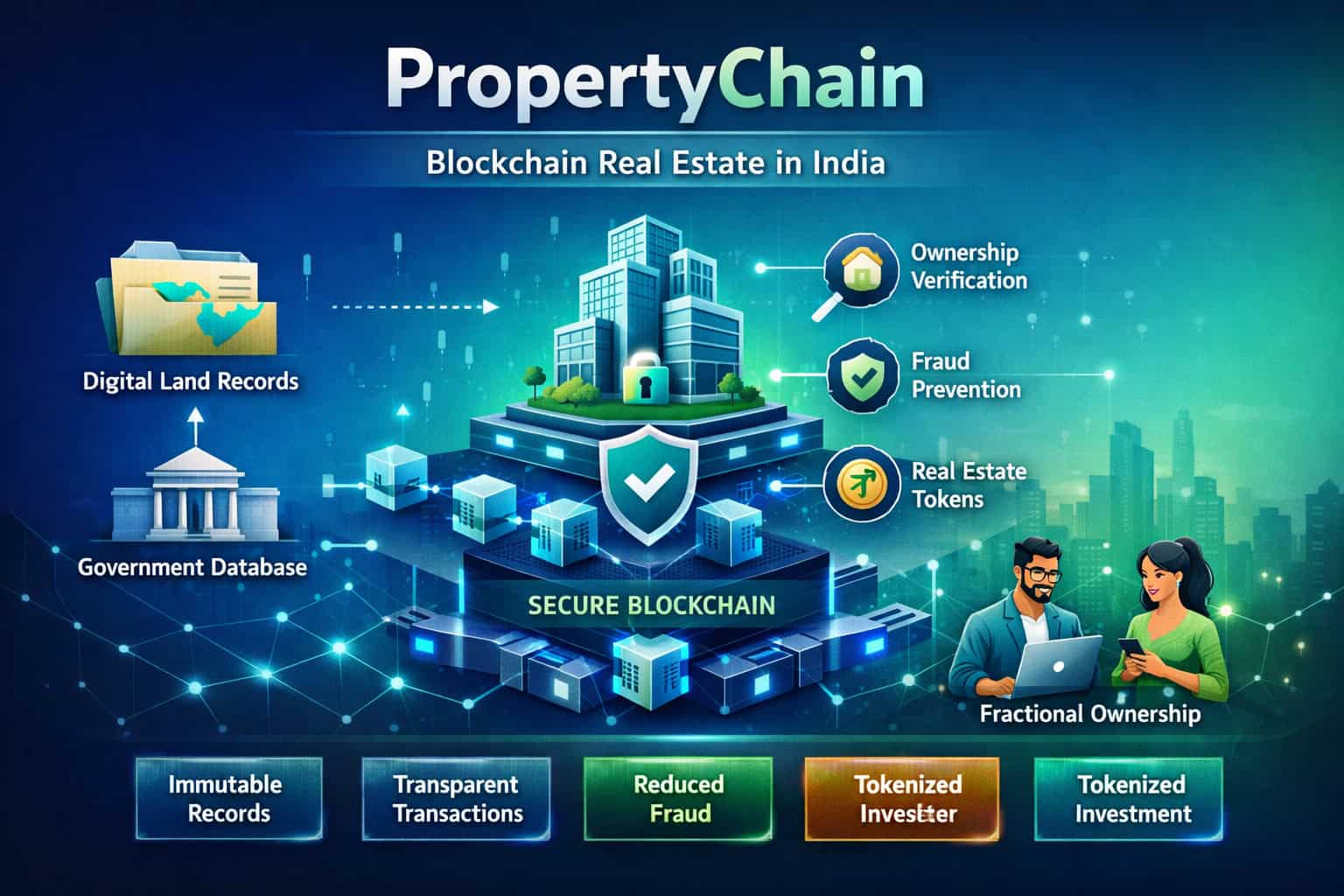
PropertyChain is a distributed ledger system. Property-related transactions get a digital record here, cryptographically linked to historical data, which builds an immutable chain of ownership events. Every transaction type that affects a property — sale, inheritance, mortgage, mutation, acquisition, or a court-ordered change — becomes a block, and the relevant government authority digitally signs it. You can review the official platform directly at PropertyChain’s government site.
How does PropertyChain India actually function, step by step?
The process follows a structured sequence:
- Authorities digitize existing land records
- They verify ownership against government databases
- The system records the verified data on the blockchain, and the relevant authority signs it digitally
- Each subsequent transaction adds a new, linked block to that property’s chain, creating a permanent and traceable record
Because each block links to the one before it, altering historical data without detection becomes extremely difficult. The full chain of ownership stays visible to authorized stakeholders too, instead of sitting buried across siloed offices.
Why does India need something like PropertyChain?
India’s current system relies heavily on presumptive titling. That means a chain of documents establishes ownership, rather than a government-guaranteed conclusive title. This structure has produced real, persistent problems: it’s hard to track whether the same land has been sold to multiple buyers, no single authoritative “golden record” of ownership exists, and disputes are slow and costly to resolve. PropertyChain’s distributed, shared ledger approach aims to reduce dependency on any single intermediary’s records. The same transaction history becomes visible and verifiable across participating stakeholders instead, rather than staying locked in one office’s files.
Does PropertyChain India actually make land ownership legally conclusive?
Not yet, and this is worth being precise about. A blockchain record being tamper-resistant is a different thing from it being legally conclusive proof of title in an Indian court. Under India’s Evidence Act, electronic records generally need certification from a specific person. That person has to confirm how the system that produced the record actually operates. A decentralized blockchain network doesn’t have a single such person by design. That gap is real, and current law hasn’t fully closed it. This isn’t a flaw unique to PropertyChain. It’s a structural legal question facing blockchain-based land records generally. In fact, it matters enough that India’s Supreme Court has pushed the government to develop a clearer framework for conclusive land titling.
In practical terms: PropertyChain genuinely strengthens transparency, traceability, and fraud resistance in how transactions get recorded. However, it adds to, rather than replaces, the formal registration and legal title process that currently determines ownership in a dispute.
How does PropertyChain connect to broader government blockchain infrastructure?
PropertyChain operates as part of India’s wider National Blockchain Framework. The Vishvasya stack sits alongside it, providing shared technical infrastructure for blockchain applications across government services. For how that broader infrastructure works, see our guide on Vishvasya Blockchain Stack in India.
What are PropertyChain’s actual current limitations?
A few genuine, practical ones:
- State-level variation. Land administration differs by state, so adoption and integration with PropertyChain isn’t uniform across the country.
- Legacy data quality. Digitizing historical records accurately takes real time and careful verification; errors in old paper records don’t disappear automatically once digitized.
- The legal-recognition gap described above, which affects how much weight a PropertyChain record carries in an actual dispute today.
How does PropertyChain relate to structured real estate investment?
As government land-record systems like PropertyChain mature, the underlying data that supports due diligence on a specific property becomes more reliable. That benefits any investment model built on accurate property information. That said, structured investment platforms typically rely on their own legal framework instead — a Trust or SPV holding the property, with investors holding a beneficial interest. They don’t depend on PropertyChain or similar government systems reaching full legal conclusiveness first. For the mechanics of that structure, see our guide on real estate tokenization in India.
Frequently Asked Questions
What is PropertyChain India?
A blockchain-based system developed by India’s National Informatics Centre to record land and property transactions in a shared, tamper-resistant ledger.
Is PropertyChain government-supported?
Yes — it’s developed by the Centre of Excellence in Blockchain Technology at NIC, and operates as part of India’s broader National Blockchain Framework.
Does PropertyChain prevent land fraud entirely?
It significantly raises the difficulty of altering or hiding fraudulent transaction history, since records stay shared and tamper-resistant across stakeholders. It doesn’t eliminate fraud risk entirely, though, or replace formal legal title verification.
Is a PropertyChain record the same as a registered land title?
No. Indian courts currently require a specific kind of certification for electronic records. Decentralized blockchain systems can’t provide that under existing evidence law. So PropertyChain records currently add to, rather than replace, formal registered title.
Can blockchain like PropertyChain support fractional real estate investment?
Indirectly — more reliable underlying property data supports better due diligence for any investment model, including fractional and tokenized structures, though those models rely on their own separate legal frameworks (typically a Trust or SPV) rather than on PropertyChain directly.