
TL;DR: India’s land record system is genuinely modernizing through two real government programs: the Digital India Land Records Modernization Programme (DILRMP) and Bhu Aadhaar, which assigns every land parcel a unique 14-digit identifier (ULPIN). Blockchain pilots are also underway in several states. However, none of this yet means blockchain records carry the same legal weight as registered title. Indian courts still require a specific kind of certification. Moreover, decentralized systems can’t currently provide this certification. Both regulators and the Supreme Court have flagged this gap.

Digital Land Records in India: Bhu Aadhaar, DILRMP, and What’s Actually Changing
For most of India’s history, proving who owns a piece of land has meant tracking down a chain of physical documents across multiple offices. During this search, people hope nothing’s missing, disputed, or quietly altered along the way. That’s slowly changing. Two real government programs — DILRMP and Bhu Aadhaar — are digitizing how land gets recorded and identified. In addition, several states are piloting blockchain on top of that foundation. It’s genuine progress. However, it’s also worth understanding exactly what’s changed so far. It’s also important to know what legal gaps still remain.
What is DILRMP, and what is it actually trying to fix?
The Digital India Land Records Modernization Programme exists because India’s land records have historically been scattered: separate registries, separate revenue department records, and physical documentation that rarely talked to each other. As a result, verifying ownership often meant checking multiple offices independently. There was no single, reliable source of truth.
DILRMP’s core objectives are straightforward:
- Digitizing existing land ownership records
- Integrating registration data with revenue department records
- Linking textual property records to actual cadastral maps
- Building toward a more unified, nationally consistent land information system
States have been digitizing property documents and linking them to geographic data under this program for a while now — it’s real, ongoing infrastructure work, not a future promise.
What is Bhu Aadhaar, and why does a land parcel need an identity number?
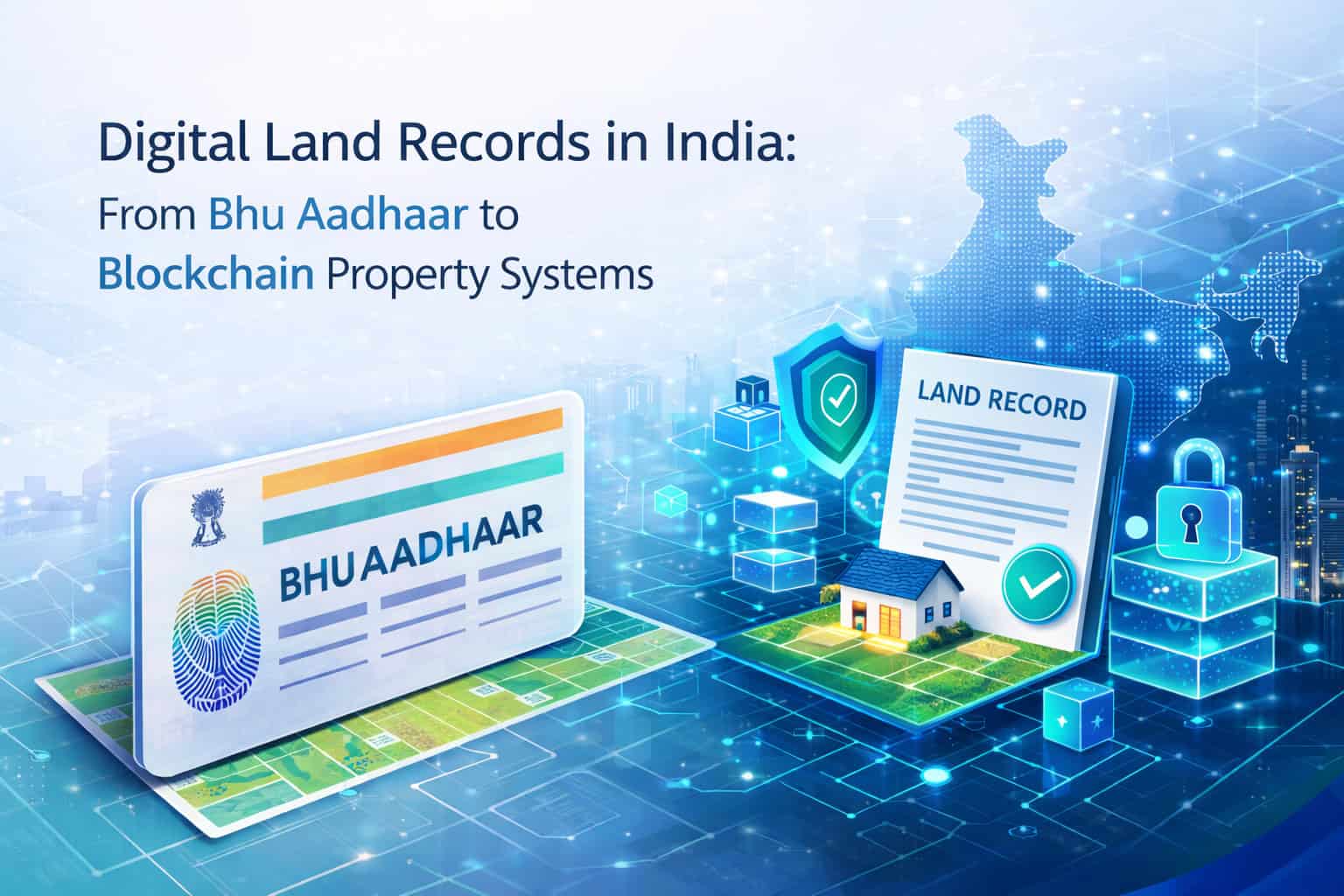
Bhu Aadhaar is one of DILRMP’s most concrete outputs: a system that gives every land parcel in India a unique digital identity, called a ULPIN (Unique Land Parcel Identification Number). It’s a 14-digit number generated from geospatial coordinates and satellite mapping. This means the identifier is tied to the actual physical location of the land. So, it’s not just a paper file reference that can get duplicated or misfiled.
The practical effect is real: a land parcel with a unique, geography-anchored identifier is harder to accidentally, or deliberately, confuse with another parcel. It’s also harder to double-register. Furthermore, it’s easier to verify quickly. That doesn’t eliminate ownership disputes. However, it removes a genuine, common source of confusion that’s plagued Indian land records for decades.
Where does blockchain actually fit into this, and where doesn’t it yet?
Several Indian states have piloted blockchain-based land record systems — Andhra Pradesh’s work in Amaravati and Telangana’s Shamshabad property registration pilot are both real, documented examples. The appeal is straightforward: blockchain creates records that are extremely difficult to alter after the fact. As a result, every change is visible across the network. It is not hidden in one office’s files.
Here’s the part worth being honest about, though: as of now, a blockchain record alone doesn’t carry the same legal weight in an Indian court as a properly registered title. India’s Evidence Act requires that electronic records be certified by a specific person who can attest to how the system that generated them actually works. However, a decentralized blockchain network, by design, doesn’t have a single such person to provide that certification. This is a real, recognized legal gap, not a minor technicality. It’s significant enough that the Supreme Court has directed the government to examine a clearer framework for conclusive land titling. This new framework could accommodate technologies like this.
What this means practically: blockchain-based land record systems genuinely strengthen transparency and make tampering much harder to do quietly. Nevertheless, they don’t yet replace the legal function of registered title. That distinction matters. It is important if you’re evaluating any claim about blockchain “proving” land ownership.
How does this connect to tokenized real estate and structured investment?
As land records get more standardized and digitized, structured investment models, including fractional ownership and tokenized participation, become more practical to build on top of. This is because accurate underlying records make due diligence considerably easier. That said, the legal structure behind a specific investment, typically a Trust or SPV holding the property, with investors holding a beneficial interest, still operates under existing property and trust law. So, it doesn’t depend on blockchain land records reaching full legal parity with registered title first. For how that structure actually works, see our guide on real estate tokenization in India.
What are the real challenges still facing this modernization effort?
A few genuine, ongoing ones:
- State-by-state inconsistency. Land administration is largely a state subject in India, so different states run different systems at different paces — full national standardization takes real time.
- Legacy data quality. Digitizing decades of paper records accurately is slow, careful work, and errors in the original records don’t disappear just because they’re now digital.
- The legal-recognition gap described above. Until that’s resolved, digital and blockchain-based records function as strong supporting evidence and transparency tools, not as a substitute for registered title.
Frequently Asked Questions
What is Bhu Aadhaar?
A system that assigns a unique digital identifier (ULPIN) to every land parcel in India, generated using geospatial coordinates and satellite mapping, under the DILRMP program.
What is ULPIN?
The Unique Land Parcel Identification Number — a 14-digit code that uniquely identifies a specific land parcel, reducing the risk of duplicate or confused records.
What is DILRMP?
The Digital India Land Records Modernization Programme, a government initiative to digitize land records, integrate registration and revenue data, and build a more unified land information system across India.
Are blockchain land records legally valid as proof of title in India?
Not yet, in the full sense. Indian courts currently require a specific kind of certification for electronic records that decentralized blockchain systems can’t provide under existing evidence law. This is a recognized legal gap that regulators and the courts are actively examining.
Does this affect how structured real estate investment works today?
Not directly. Structured investment platforms typically operate through a Trust or SPV under existing property and trust law, independent of whether blockchain land records achieve full legal parity with registered title.