
TL;DR: Fractional real estate investments in India generate three main tax events: rental income distributions, capital gains on exit, and TDS deducted at source. The applicable rates depend on whether you are a resident or NRI investor, how long you held the investment, and which legal structure the platform uses. This guide covers each tax event specifically, with relevant sections of the Income Tax Act, 1961 cited throughout.

Tax Guide: How Fractional Real Estate Investments Are Taxed in India
When you invest in fractional real estate in India, tax applies at every stage: when the platform distributes rental income, when you exit the investment, and when the platform deducts TDS on your distributions. Consequently, understanding the tax treatment upfront helps you plan your investment structure and avoid surprises at filing time. Therefore, this guide covers the complete tax picture for fractional real estate investors in India.
Understand how your fractional real estate investment is taxed — before you invest.
Landbitt structures every investment through a registered Trust under the Indian Trusts Act, 1882. You hold documented profit rights via an SPV NFT certificate — taxed as real property interests under the Income Tax Act, 1961. PMLA-compliant KYC. Starting from 1 sq. ft. or ₹20,000.
Quick Facts
- Three tax events: Rental income distributions, capital gains on exit, and TDS deducted at source by the platform or Trustee.
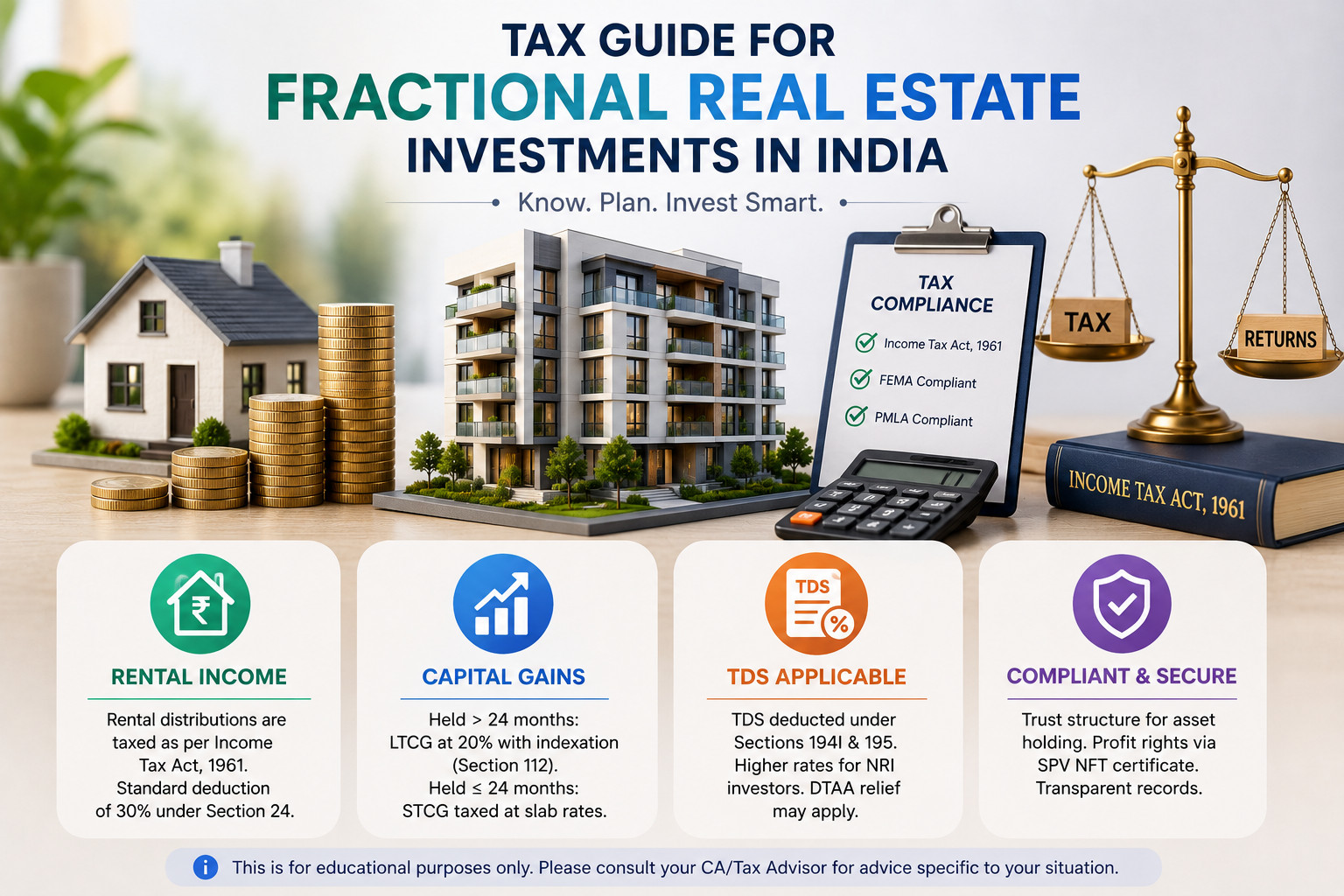
- Holding period matters: Assets held for more than 24 months qualify for long-term capital gains (LTCG) treatment. Assets held for 24 months or less attract short-term capital gains (STCG) rates.
- Resident vs NRI rates: NRI investors face higher TDS rates and different repatriation rules. DTAA relief may apply for NRIs from eligible countries.
- Key law: Income Tax Act, 1961 governs capital gains, rental income, and TDS for real estate investments in India.
- Note: This guide provides general information only. Investors should consult a qualified chartered accountant or tax advisor for advice specific to their situation.
Tax Event 1: Rental Income Distributions
How the Tax Works
When a fractional real estate platform distributes rental income to investors, the Income Tax Act, 1961 treats this income as “income from house property” (Section 22) or as business income, depending on the platform’s structure and holding vehicle. Specifically, for Trust/SPV model platforms, the Trust distributes income to beneficiary investors. Consequently, the tax treatment follows the instrument — profit rights under a Trust structure typically result in income taxed in the hands of the investor at their applicable slab rate.
Standard Deduction and Net Rental Income
Under Section 24 of the Income Tax Act, 1961, investors may claim a standard deduction of 30% of net annual value for income from house property. This deduction reduces the taxable rental income. Furthermore, investors may also deduct interest paid on any loan taken to finance the investment, subject to applicable limits. Consequently, the effective tax on rental distributions may be lower than the gross distribution amount suggests.
TDS on Rental Distributions
Platforms or Trustees distributing rental income to investors must deduct TDS as applicable. For resident investors, TDS applies at the rates prescribed under the Income Tax Act, 1961. For NRI investors, higher TDS rates apply — generally 30% unless DTAA relief reduces this. Moreover, TDS certificates (Form 16A) must be issued by the deductor and should be collected by investors for tax filing purposes.
Tax Event 2: Capital Gains on Exit
Long-Term Capital Gains (LTCG)
If you hold your fractional real estate investment for more than 24 months, gains on exit qualify as long-term capital gains under Section 112 of the Income Tax Act, 1961. Specifically, LTCG on real estate attracts a tax rate of 20% with the indexation benefit. Indexation adjusts the cost of acquisition for inflation using the Cost Inflation Index (CII) published by the Government of India each year. Consequently, indexation significantly reduces the taxable gain, especially for longer holding periods.
Short-Term Capital Gains (STCG)
If you hold your investment for 24 months or less, gains on exit qualify as short-term capital gains. Short-term capital gains on real estate are taxed at the investor’s applicable income tax slab rate — not at a flat rate. Therefore, the actual STCG tax rate depends on the investor’s total income for that financial year. For investors in the highest slab, this rate reaches 30% plus applicable surcharge and cess.
Reinvestment Exemptions Under Section 54EC
Investors who realise long-term capital gains from real estate may reinvest those gains in specified bonds under Section 54EC of the Income Tax Act, 1961 to defer tax. Currently, qualifying bonds include bonds issued by NHAI (National Highways Authority of India) and REC (Rural Electrification Corporation). Moreover, the investment cap under Section 54EC is ₹50 lakh per financial year. Consequently, investors with gains exceeding this cap must pay LTCG tax on the excess amount.
Tax Event 3: TDS Framework
TDS for Resident Investors
TDS on rental income from real estate applies under Section 194I of the Income Tax Act, 1961. Specifically, when annual rental payments exceed ₹2.4 lakh, the tenant or payer must deduct TDS at 10% for individual and HUF investors. For platforms distributing rental income to multiple fractional investors, the TDS calculation applies per investor based on their proportional share of the total distribution. Furthermore, resident investors can claim TDS credit when filing their annual income tax return.
TDS for NRI Investors
For NRI investors, TDS applies at higher rates under Section 195 of the Income Tax Act, 1961. Generally, the applicable TDS rate is 30% plus surcharge and cess on rental income distributions to NRIs. Moreover, for capital gains distributions, the TDS rate corresponds to the applicable capital gains tax rate. However, NRI investors from countries with which India has a Double Taxation Avoidance Agreement (DTAA) may claim reduced TDS rates. To claim DTAA relief, NRI investors must provide a valid Tax Residency Certificate, a self-declaration in Form 10F, and any other documents the platform requires.
GST and Stamp Duty Considerations
GST on Platform Fees
GST (Goods and Services Tax) may apply to management fees, advisory fees, or other service charges that the platform levies. Specifically, management services fall under GST at 18%. Consequently, investors should review the platform’s fee schedule and determine which fees include GST and whether they can claim input tax credit, depending on their investor status and entity type.
Stamp Duty on Trust Deed Registration
When a Trust/SPV platform registers a Trust Deed for a new asset, stamp duty applies under applicable state laws. Specifically, stamp duty rates vary by state and are calculated on the property value. Moreover, for NFT certificate instruments, the stamp duty treatment continues to evolve as regulators develop guidance on digital asset instruments. Consequently, investors should confirm stamp duty treatment with the platform and their own tax advisor.
Tax Planning Considerations for Fractional Investors
Holding Period Planning
The most significant tax planning decision for fractional real estate investors is whether to hold for at least 24 months to qualify for LTCG treatment. Specifically, moving from STCG (taxed at slab rate) to LTCG with indexation (taxed at 20%) can significantly reduce the effective tax rate on gains. Therefore, investors should factor in the expected holding period when selecting investments and planning exits.
DTAA Planning for NRIs
NRI investors should proactively obtain their Tax Residency Certificate from their country of residence before investing. Furthermore, they should submit Form 10F to the platform at the start of each financial year to ensure DTAA relief applies to their distributions. Consequently, this step can reduce TDS from 30% to a significantly lower rate depending on the applicable DTAA provisions for their country of residence.
How Landbitt Handles Tax Reporting
TDS Compliance
Landbitt deducts TDS on distributions to investors in accordance with the Income Tax Act, 1961 and provides TDS certificates (Form 16A) to investors for use in their annual tax filings. Moreover, Landbitt maintains records of all distributions and deductions in compliance with Income Tax Act requirements. Consequently, investors receive the documentation they need for accurate tax filing.
Investor Responsibility
While Landbitt handles TDS compliance at the distribution level, each investor remains responsible for filing their own income tax return, declaring all income from fractional investments, and claiming any applicable deductions or exemptions. Specifically, investors should consult a qualified chartered accountant to ensure their returns accurately reflect their fractional real estate income and gains. Landbitt does not provide individual tax advice.
Internal Links for Further Research
For a complete checklist of how to verify a fractional platform before investing, read our Platform Verification Checklist. To understand the Trust/SPV legal structure that governs how income is distributed, see our guide on the Indian Trusts Act, 1882. Furthermore, if you are an NRI investor, our NRI Investment Guide covers FEMA compliance and repatriation rules. For authoritative tax information, refer to the Income Tax Department’s official website.
Frequently Asked Questions
How is rental income from fractional real estate taxed in India?
Rental income distributions from fractional real estate investments are generally taxed as income from house property under Section 22 of the Income Tax Act, 1961. Investors may claim a standard deduction of 30% of net annual value under Section 24. The remaining income is taxed at the investor’s applicable slab rate. Moreover, TDS applies to distributions above prescribed thresholds.
What is the capital gains tax on fractional real estate in India?
Long-term capital gains (on investments held more than 24 months) are taxed at 20% with indexation benefit under Section 112 of the Income Tax Act, 1961. Short-term capital gains (held 24 months or less) are taxed at the investor’s applicable income tax slab rate. Therefore, holding an investment for more than 24 months significantly reduces the tax rate on gains.
What TDS applies to fractional real estate distributions?
For resident investors, TDS on rental income applies under Section 194I at 10% when annual payments exceed ₹2.4 lakh. For NRI investors, TDS applies at higher rates under Section 195 — generally 30% on rental income unless DTAA relief reduces this. Moreover, capital gains distributions to NRIs attract TDS at the applicable capital gains tax rate.
Can I save capital gains tax on fractional real estate exits?
Yes. Long-term capital gains from real estate can be deferred by reinvesting in specified bonds under Section 54EC of the Income Tax Act, 1961. The current investment cap is ₹50 lakh per financial year. Qualifying bonds include those issued by NHAI and REC. Consequently, investors with gains up to ₹50 lakh may defer their LTCG tax liability through this route.
What tax documentation does Landbitt provide?
Landbitt provides TDS certificates (Form 16A) to investors for all TDS deducted on distributions. These certificates allow investors to claim TDS credit when filing their annual income tax return. Additionally, Landbitt maintains distribution records in compliance with the Income Tax Act, 1961 requirements. Investors should retain these documents and consult a chartered accountant for their individual tax filing.
Invest with full clarity on the tax implications.
Landbitt provides TDS certificates (Form 16A) and maintains distribution records per Income Tax Act, 1961 requirements. You hold profit rights via SPV NFT certificate — not equity, not title. PMLA-compliant KYC. Starting from 1 sq. ft. or ₹20,000.