

TL;DR: Land investment vs fractional ownership in India isn’t really a contest between a good option and a bad one — it’s a tradeoff between control and capital. Buying land directly gives you full ownership and full responsibility for a larger upfront cost. Fractional ownership lowers that entry cost and hands the operational work to a platform, in exchange for a smaller, shared stake. Most people choose based on how much capital they have and how much control actually matters to them.

Land Investment vs Fractional Ownership in India: Which Actually Fits You?
There’s a particular kind of stuck most new real estate investors get to eventually: you’ve decided land is the right asset class, but you haven’t decided how you want to actually hold it. Buying a plot outright is the traditional route. Fractional ownership is the newer one. Neither is objectively better — they’re built for different situations, and the right one depends more on your own capital and patience than on which model is “smarter.”
What does buying land directly actually involve?
Direct land investment means exactly what it sounds like: you buy a plot, you register it in your name, and you’re fully responsible for everything that follows — legal verification, holding costs, eventual resale. The upside is real control. You decide when to sell, how to use the land, and you don’t share the upside with anyone. The tradeoff is that all of that requires real capital upfront, and you’re doing the legal and administrative legwork yourself, or paying someone else to do it.
What does fractional ownership actually involve?
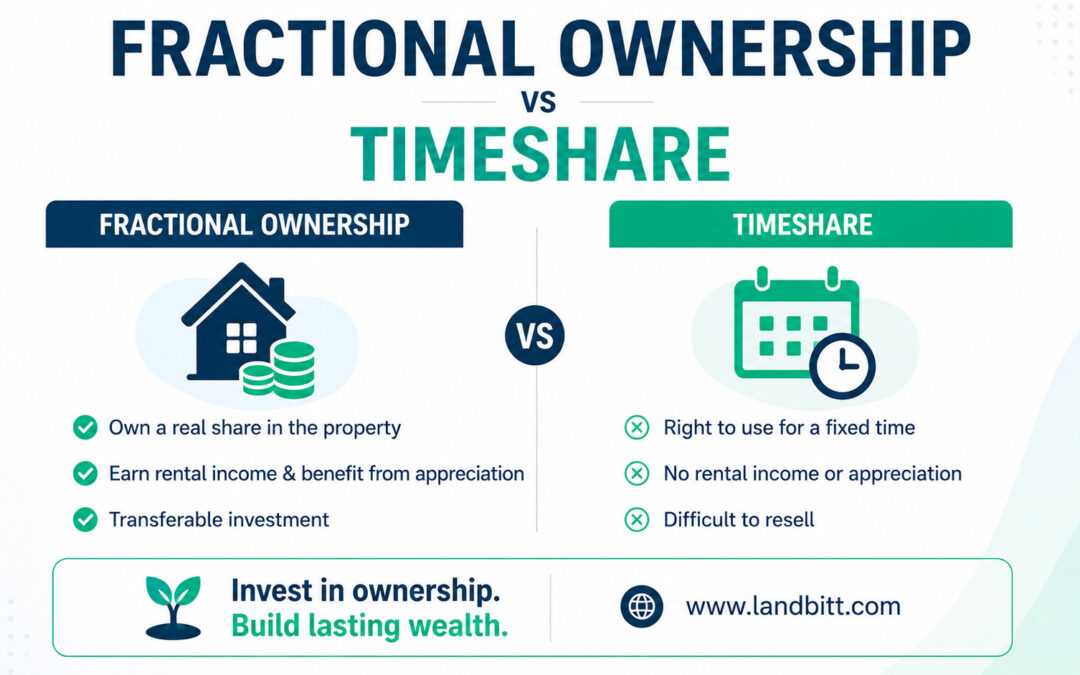
Fractional ownership splits that equation differently. Instead of buying an entire plot, you hold a proportional economic interest in one, alongside other investors, through a trust or SPV structure that defines everyone’s rights upfront. The platform handles the legal documentation, the title verification, and the ongoing administration. In exchange, you don’t get the full upside of owning the asset outright — your return matches your share, not the whole property’s appreciation.
How do the two actually compare side by side?
| What matters to you | Direct Land Purchase | Fractional Ownership |
|---|---|---|
| Capital required | High | Moderate to low |
| Who manages it | You | The platform |
| Control over decisions | Full | Shared, governed by agreed terms |
| Returns | Full appreciation, no sharing | Proportional appreciation and any rental income |
| Getting your money out | Depends entirely on finding a buyer | Often faster, through a managed resale process |
Why does this choice matter more for beginners specifically?
If you’re new to land investment, fractional ownership tends to lower the stakes of a mistake. The capital commitment is smaller, the legal documentation has already been worked through by the platform, and you’re not solely responsible for catching every red flag in a title search yourself. That’s not nothing — a lot of the real risk in direct land purchase comes from exactly the kind of due diligence gaps a first-time buyer is most likely to miss.
Direct purchase can still make sense for a beginner with patience and a genuine interest in learning the process, but it asks more of you upfront, with less of a safety net if something goes wrong.
What are the actual risks on each side?
Direct land purchase risks:
- Legal verification gaps — title disputes are a real and recurring problem in Indian land transactions
- Development delays in the surrounding area, which can stall appreciation for years
- No structured exit — you’re entirely dependent on finding your own buyer
Fractional ownership risks:
- Platform dependency — your protection is only as good as the platform’s actual legal structure and documentation
- Liquidity limits — resale still depends on demand, even if the process is more structured
- Returns capped to your specific share, with no ability to capture more upside even if the asset performs exceptionally well
Neither model removes risk. They just distribute it differently.
How do modern platforms actually change the picture?
This is where the comparison has shifted the most in the last few years. Platforms structuring fractional ownership properly — with a documented SPV, real KYC verification, and transparent governance — have made the model considerably more credible than it was when “fractional real estate” mostly meant informal investor syndicates with no real legal backbone. For the full mechanics of how that structure works, see our guide on fractional ownership in India.
So which one should you actually choose?
A genuinely useful way to think about it:
- Choose direct land purchase if you have substantial capital, want full control, and are comfortable handling (or paying for) your own legal and administrative due diligence.
- Choose fractional ownership if you want real estate exposure without the full capital commitment, and you’re comfortable trading some control for a platform-managed structure.
Plenty of experienced investors do both — direct ownership for one or two larger, carefully chosen assets, and fractional participation to diversify across several smaller positions they couldn’t otherwise afford to spread across. For a deeper look at the land-specific mechanics behind that second approach, our fractional land investment guide covers it in detail.
Frequently Asked Questions
Land investment vs fractional ownership — which gives better returns?
Direct land purchase gives you the full appreciation on the asset, with no sharing. Fractional ownership gives you proportional appreciation tied to your specific share, plus any rental income the asset generates. Neither guarantees better returns — it depends on the specific asset’s performance either way.
Is fractional ownership safer than buying land directly?
It can reduce certain risks — particularly the due-diligence burden that falls entirely on you with a direct purchase — but it introduces platform-dependency risk in exchange. Both carry real risk; they’re just different kinds.
Can I do both?
Yes, and many experienced investors do — direct ownership for a smaller number of carefully chosen assets, fractional participation to diversify more broadly without needing the capital for several full purchases.
Which is better for someone just starting out?
Fractional ownership tends to lower the stakes of a first mistake, since the capital commitment is smaller and the legal documentation is already handled by the platform. Direct purchase can still work for a patient beginner willing to learn the process closely.
How do I start with fractional ownership specifically?
Review the platform’s actual legal structure (ideally a documented Trust or SPV), complete KYC verification, and review the specific asset’s documentation before committing — see our fractional ownership in India guide for the full process.