
TL;DR: REITs are SEBI-regulated, exchange-traded vehicles offering pooled, liquid exposure to commercial real estate. Fractional ownership gives you asset-specific exposure to one property through a trust-based SPV, with returns and risk tied directly to that property rather than a diversified portfolio. Neither guarantees returns — the right choice depends on whether you value liquidity or asset-level transparency more.

REIT vs Fractional Ownership in India: Which Is Better for Investors in 2026?
Real estate investing in India has changed substantially over the past decade. You no longer need to buy an entire property to participate in the market — two structured alternatives have emerged: Real Estate Investment Trusts (REITs) and fractional ownership models. If you’re weighing REIT vs. fractional ownership, you’re really evaluating liquidity, return structure, risk exposure, and control. Both offer structured access to real estate, but they work in genuinely different ways. Here’s the actual breakdown.
What is a REIT in India?
A Real Estate Investment Trust is a SEBI-regulated vehicle that pools investor money into income-generating commercial real estate — office parks, malls, business complexes. Stock exchanges list and trade REIT units, so you buy and sell them like shares.
Key features:
- Regulated by SEBI
- Listed and traded on stock exchanges
- Diversified commercial real estate exposure
- Professional asset management
- Dividend distribution from rental income
REITs suit investors who want liquidity and are comfortable with stock-market-style trading.
What is fractional ownership in India?
Fractional ownership lets multiple investors participate in one specific property by holding proportional economic rights. Instead of pooling across dozens of assets the way a REIT does, participation is typically asset-specific. Modern structured platforms combine trust-based SPV frameworks with digital recordkeeping for transparency and governance.
How do the legal structures differ?
REIT legal structure:
- Regulated under SEBI REIT Regulations
- A trust structure holds the assets
- Diversified across multiple properties
- Investors don’t choose individual properties
Fractional ownership legal structure:
- Typically structured via trust-based SPV models
- Asset-specific participation
- Clear mapping of economic rights to the property you chose
- Income that ties directly to that single property
How does liquidity compare?
This is one of the most important differences between the two.
REIT liquidity: units trade on stock exchanges, offering high liquidity during market hours, with prices that move with market sentiment.
Fractional ownership liquidity: secondary transfer may be available after a defined lock-in period, but liquidity depends entirely on buyer demand — there’s no exchange backing it.
REITs win on liquidity speed. Fractional ownership trades that for asset-level transparency and a medium-term holding orientation.
How does the returns structure differ?
REIT returns: regular dividend income, capital appreciation through market price, market-driven volatility.
Fractional ownership returns: rental income from your specific property, capital appreciation linked to that property’s performance, and risk tied to both the market and that individual asset.
Neither model guarantees returns. Both depend on economic conditions, infrastructure growth, and demand cycles.
How does the risk profile differ?
REIT risks: stock market volatility, interest rate sensitivity, portfolio-level performance swings.
Fractional ownership risks: asset-specific risk, liquidity limitations, regulatory evolution risk as India’s frameworks for these structures continue to develop.
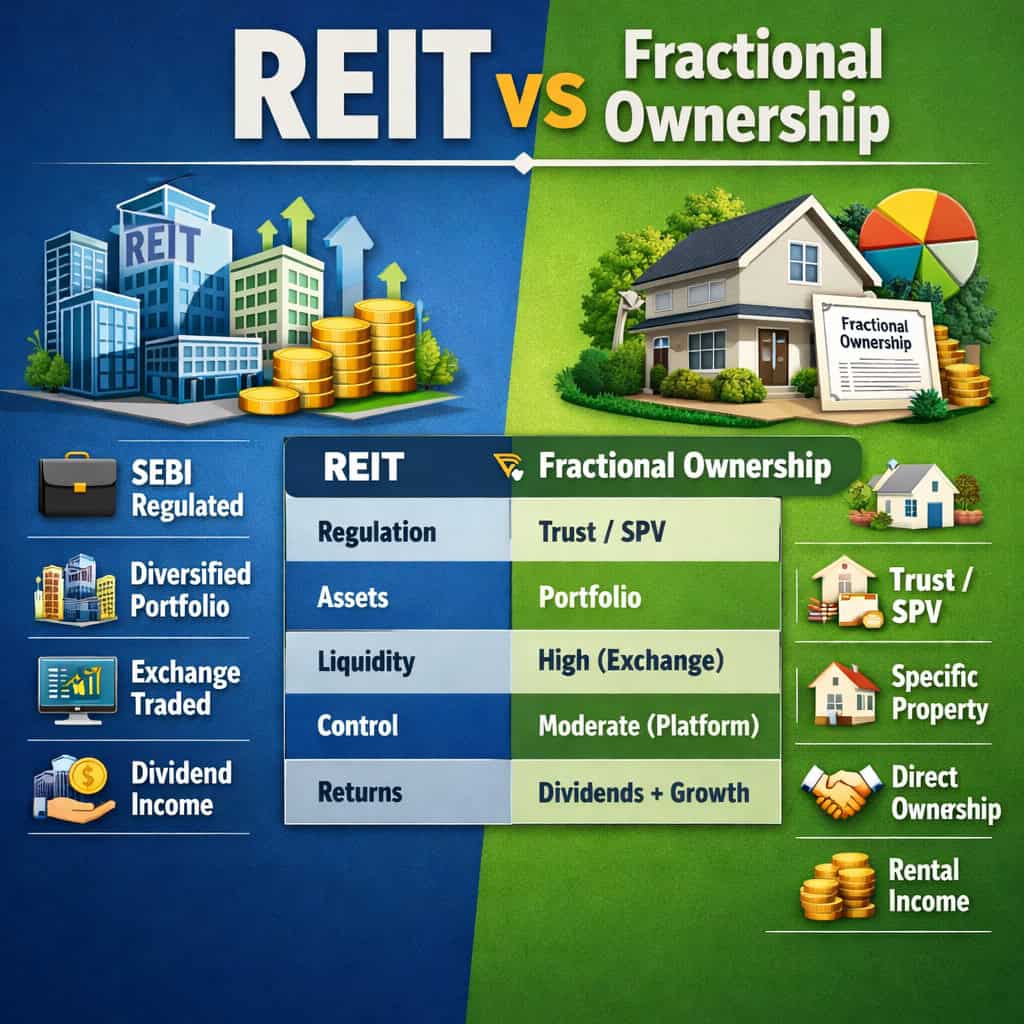
Quick comparison
| Factor | REIT | Fractional Ownership |
|---|---|---|
| Regulation | SEBI Regulated | Trust / SPV Structured |
| Asset selection | Pooled portfolio | Specific property |
| Liquidity | Exchange traded | Platform-based transfer |
| Minimum investment | Relatively low | Varies by platform |
| Return source | Dividend + appreciation | Rental + appreciation |
| Risk exposure | Market linked | Property linked |
Who should choose a REIT?
- Investors who want high liquidity
- Those comfortable with stock market fluctuations
- Investors wanting diversified commercial exposure
- Passive investors who’d rather have a fund manager handle decisions
Who should choose fractional ownership?
- Investors who want asset-level visibility into exactly what they own
- Those seeking structured participation in specific properties
- Investors comfortable with a medium-term holding period
- Diversification-focused real estate investors adding a real-asset component
How to actually decide
Ask yourself directly:
- Do I prefer exchange liquidity or asset-level transparency?
- Am I comfortable with market-driven volatility?
- What’s my actual investment horizon?
- Do I want diversified exposure, or property-specific participation?
Both models modernize how real estate investing works in India. Which one is right depends on your financial goals and risk tolerance — not on which one is being marketed harder.
Related guides
Frequently Asked Questions
Is a REIT safer than fractional ownership in India? REITs are SEBI-regulated and exchange-traded, which gives transparency and liquidity — but they’re still exposed to market volatility and interest rate changes. Fractional ownership depends on one specific property’s performance and legal structure. Both carry real investment risk, and neither guarantees returns.
Can I sell fractional ownership anytime? Not anytime — there’s typically a defined lock-in period. After that, you can transfer through a structured secondary marketplace, subject to buyer availability and compliance requirements. Liquidity depends on actual demand, not a guaranteed window.
Do both REITs and fractional ownership provide rental income? Yes. REITs distribute dividends from rental income across their pooled portfolio. Fractional ownership distributes the rental income your specific property generates.
Which offers better returns — REIT or fractional ownership? Neither guarantees better returns. REIT returns move with stock market dynamics; fractional ownership returns are tied directly to your selected property’s performance. Both depend on market conditions, demand cycles, and economic factors outside either model’s control.
Is fractional ownership suitable for long-term investors? Generally yes — it tends to suit medium-to-long-term investors who want asset-level participation, rather than investors looking for exchange-based trading flexibility.