

TL;DR: The minimum investment in fractional real estate in India depends entirely on the platform and how it structures entry — some price participation by rupee amount, others by a unit of the asset itself. On Landbitt, the minimum is 1 sq. ft. of a property’s value, or ₹20,000 — whichever is higher. So for lower-value properties where 1 sq. ft. comes to less than ₹20,000, the ₹20,000 floor applies; for higher-value properties, the sq. ft. value itself becomes the minimum. Across the industry more broadly, ranges vary widely: from a few thousand rupees on entry-level platforms to several lakhs for premium commercial assets.

Minimum Investment in Fractional Real Estate in India
The minimum investment in fractional real estate in India has become a central question for investors who want exposure to property markets without buying an entire asset outright. Traditional real estate demanded large capital commitments upfront, putting ownership out of reach for most individuals. Fractional ownership models change that calculation — but “minimum investment” doesn’t mean the same thing on every platform, and understanding how it’s actually structured matters more than the headline number.
What is fractional real estate investment?
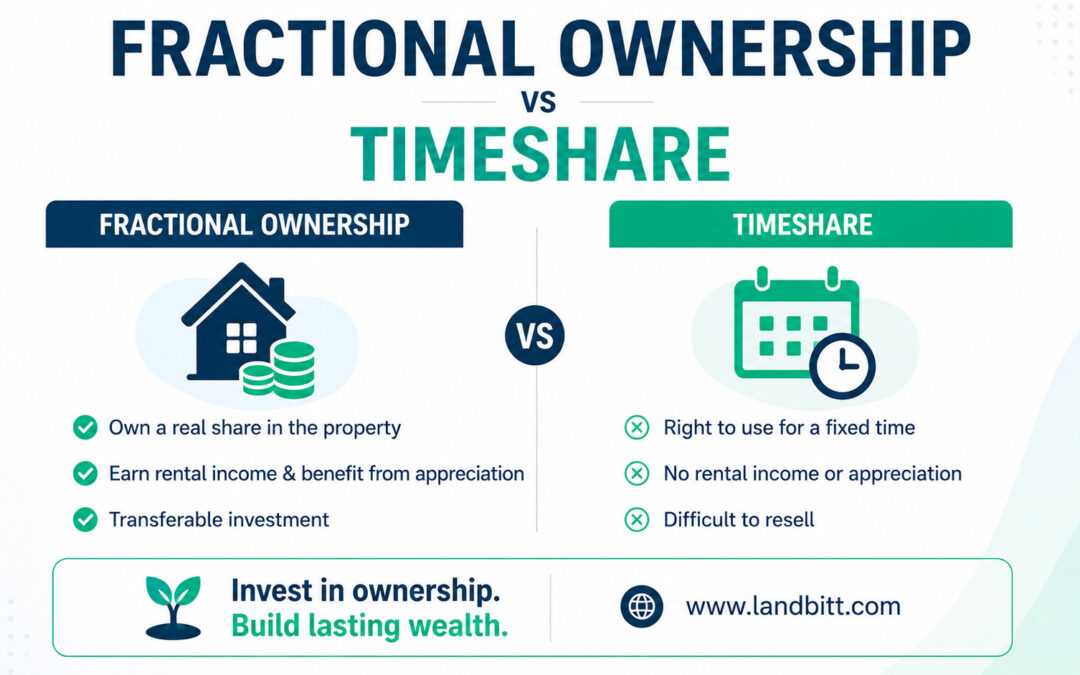
Fractional real estate investment lets multiple investors collectively hold a share in a property asset. Instead of buying an entire property, you purchase a fractional share representing a portion of it — giving you exposure to premium real estate that would otherwise require a far larger commitment. For the fuller picture of how this differs from tokenized models specifically, see our guide on real estate tokenization vs. fractional ownership in India.
How is the minimum investment actually structured?
This is where it gets platform-specific, and it’s worth understanding before comparing numbers across providers:
Rupee-based minimums. Many platforms set a flat minimum rupee amount per investment — commonly ranging from roughly ₹10,000 on entry-level platforms up to ₹5–25 lakh for premium commercial assets, and higher still for institutional-grade properties.
Unit-based minimums. Some platforms, including Landbitt, instead price participation by a physical unit of the asset — for example, starting from 1 sq. ft. of a property’s value. On Landbitt specifically, the actual minimum is 1 sq. ft. of the property’s value, or ₹20,000 — whichever is higher. In practice, this means: for a high-value property where 1 sq. ft. is worth more than ₹20,000, that sq. ft. value itself sets your minimum. For a lower-value property where 1 sq. ft. comes to less than ₹20,000, the ₹20,000 floor applies instead. So the actual rupee figure varies listing to listing, but it never drops below ₹20,000.
Neither approach is inherently better — they’re just different ways of lowering the entry barrier. What matters more is understanding which structure a given platform uses before you compare its “minimum investment” to a competitor’s.
Why is fractional real estate growing in India?
Fractional ownership has gained real traction because it addresses several long-standing barriers to property investment:
- Lower capital requirement to get started
- Access to premium commercial assets that would otherwise be out of reach
- The ability to diversify across multiple properties rather than one
- Shared ownership risk instead of concentrated exposure
- More transparent investment structures than informal co-ownership arrangements
Digital infrastructure — blockchain-based recordkeeping in particular — is also improving transparency across this category. See our guide on blockchain in real estate for how that works.
What role does technology play here?
Modern PropTech platforms use digital infrastructure to manage investor onboarding, ownership verification, and governance — reducing the manual paperwork that traditionally slowed fractional arrangements down. Broader land-record digitization efforts in India are reinforcing this shift as well; see our overview of how that’s progressing nationally for context.
How does structured participation actually work?
Structured property participation platforms let investors take part in property investments through organized governance frameworks — typically a trust or SPV structure rather than informal agreements between individuals. This tends to improve transparency and, in many cases, gives investors defined governance rights alongside their economic stake.
What are the real risks?
Lower entry cost doesn’t mean lower risk. Before participating, weigh:
- Liquidity limitations — exiting depends on finding a buyer, with no guaranteed timeline.
- Platform dependency — your investment’s integrity depends on the platform’s own operational and legal soundness.
- Regulatory evolution — frameworks governing fractional and tokenized real estate in India are still developing.
- Market fluctuations — the underlying property’s value still moves with broader market conditions.
- Property management risk — how well (or poorly) the asset is managed directly affects your returns.
A lower minimum investment lowers your capital barrier, not your exposure to these risks.
Where is this headed?
As technology matures and regulatory frameworks evolve, structured real estate participation is likely to become more widely adopted — and minimum entry points are likely to keep trending lower as platforms compete on accessibility. That said, lower minimums make evaluating platform quality and legal structure more important, not less, since smaller checks deserve the same diligence as larger ones.
Frequently Asked Questions
What is the minimum investment in fractional real estate in India?
It varies significantly by platform and structure. Some price participation by a fixed rupee amount (commonly from ₹10,000 upward); others price it by a physical unit of the asset. Landbitt uses a hybrid rule: the minimum is 1 sq. ft. of a property’s value, or ₹20,000, whichever is higher — so the exact figure depends on the specific property, but never falls below ₹20,000.
Is fractional real estate legal in India?
Fractional structures operate through existing legal frameworks — typically trusts or SPVs — rather than a dedicated fractional-ownership statute. Always review a platform’s specific legal documentation and trust deed before investing, not just its marketing claims.
How do investors earn returns in fractional real estate?
Through rental income distribution, property appreciation, or asset resale, depending on the specific investment structure and the property in question.
Can investors sell fractional property shares?
Liquidity depends on the platform and market demand. Some platforms allow resale through a structured secondary marketplace, typically after a defined lock-in period.